

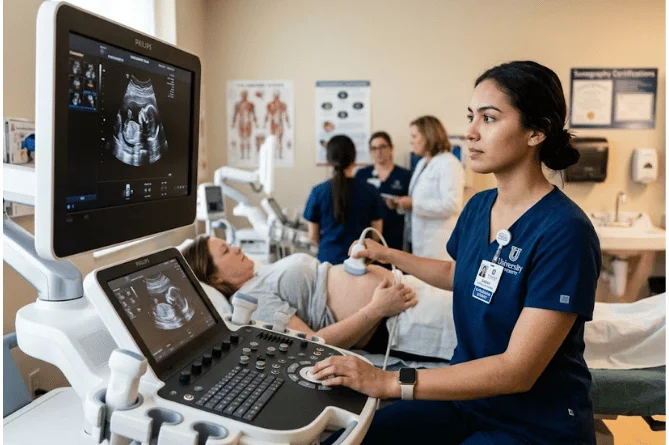
An associate’s degree in diagnostic medical sonography can provide a relatively direct route into a specialized healthcare career without requiring four years of college. Students learn to use ultrasound equipment, understand anatomy and pathology, work safely with patients, and produce diagnostic images that physicians use to evaluate medical conditions. The degree can be attractive if you want hands-on patient care, technical work, and strong employment prospects but do not want to attend medical or nursing school.
Direct answer: An associate’s degree in diagnostic medical sonography is typically a two-year, full-time program combining anatomy, ultrasound physics, patient care, laboratory instruction, and supervised clinical rotations. In the U.S., choosing a CAAHEP-accredited program can streamline ARDMS exam eligibility and provide a clearer path to entry-level sonography employment.
| Quick fact | What U.S. students should know |
|---|---|
| Typical entry education | Associate’s degree or postsecondary certificate |
| Typical degree length | About two years of full-time study at many schools |
| Training format | Classroom, laboratory, and supervised clinical education |
| Key accreditation | CAAHEP programmatic accreditation |
| Common credential | RDMS through ARDMS after required examinations |
| 2025 median U.S. pay | $96,590 per year |
| 2025–2035 job growth | 14%, much faster than the average for all occupations |
| Projected openings | About 6,000 per year on average |
What Is an Associate’s Degree in Diagnostic Medical Sonography?
A diagnostic medical sonography associate degree is an undergraduate healthcare program that prepares students to create medical images using high-frequency sound waves. Sonographers position patients, operate ultrasound equipment, select appropriate imaging settings, recognize normal and abnormal anatomy, and record images for interpretation by physicians. Although the job is sometimes called “ultrasound technician,” the occupational title used by the U.S. Bureau of Labor Statistics is “diagnostic medical sonographer.”
An associate program is not simply a collection of classroom science courses. BLS notes that sonography education typically includes clinical training in a healthcare facility under the direction of experienced professionals, meaning students must demonstrate practical scanning and patient care skills before graduation. This combination of technical instruction and clinical experience is one reason prospective students should compare programs by outcomes and accreditation rather than choosing on tuition or convenience alone.
How Long Does a Diagnostic Medical Sonography Associate Degree Take?
Many U.S. associate programs are designed to take approximately two years once a student enters the professional sonography sequence. Central Arizona College, for example, describes its AAS as two years of full-time study over six sequential semesters, while Saint Joseph’s University lists its associate degree as a 24-month, 67-credit program. The actual time from the first college class to graduation may be longer when prerequisites must be completed before competitive admission.
That distinction matters when comparing “two-year” programs. A school may require anatomy, physiology, physics, mathematics, communication, or other college courses before a student can begin the sonography sequence, so the professional phase may take two years in addition to earlier prerequisite work. Del Mar College’s current plan, for instance, includes prerequisite coursework before its sonography semesters, and its full associate degree totals 65 semester hours.
Can You Earn a Sonography Degree Online?
Some schools offer online or hybrid instruction for the academic portion of the degree, but a legitimate sonography education still requires hands-on laboratory and clinical training. AIMS Education, for example, describes its 24-month CAAHEP-accredited associate program as hybrid while still requiring lecture, laboratory, and clinical hours with schedules that vary by semester. A program advertising a completely online path with no supervised scanning experience should therefore be subject to careful scrutiny before you enroll.
Admission Requirements Can Be More Competitive Than Expected
Admission standards differ because individual schools set their own requirements, and CAAHEP does not set a single nationwide admissions formula for all accredited programs. Common prerequisites seen in current programs include anatomy and physiology, college mathematics, physics, English or communications, and introductory healthcare coursework. Baptist Health System School of Health Professions, for example, requires Anatomy and Physiology I and II, college algebra, communication, and physics, along with a minimum TEAS score for its program.
| Possible admission component | Why programs may require it |
|---|---|
| Anatomy and physiology | Builds the foundation for identifying structures on ultrasound |
| Physics | Supports understanding of sound waves and image formation |
| College algebra or math | Helps prepare students for ultrasound physics |
| Medical terminology | Builds familiarity with clinical language |
| Entrance examination | Helps programs rank applicants |
| Minimum prerequisite GPA | Demonstrates readiness for intensive coursework |
| Observation or information session | Helps applicants understand the profession |
| Background check or health requirements | May be required before clinical placement |
Meeting the minimum requirements does not always guarantee admission because many sonography programs have limited clinical placements. Some schools use selective admissions and rank candidates based on prerequisite grades, examinations, prior healthcare preparation, or other criteria. Lincoln Land Community College, for example, identifies its AAS in diagnostic medical sonography as a selective-admission program rather than an open-enrollment major.
What Will You Study in a Sonography Associate Degree?
The curriculum blends medical science, imaging technology, and patient care. BLS identifies anatomy, medical terminology, applied sciences, specialty sonography instruction, and supervised clinical work as common components of sonography education. Current college curricula also show courses in ultrasound physics, sectional anatomy, abdominal imaging, obstetric and gynecologic sonography, patient care, and progressively advanced clinical practicums.
| Area of study | What you learn |
|---|---|
| Anatomy and physiology | Structure and function of organs and body systems |
| Ultrasound physics | How sound behaves and how equipment creates images |
| Abdominal sonography | Imaging organs such as the liver, gallbladder, pancreas, spleen, and kidneys |
| OB/GYN sonography | Imaging related to pregnancy and the female reproductive system |
| Patient care | Communication, positioning, safety, privacy, and professional conduct |
| Pathology | How disease can change anatomy and sonographic appearance |
| Scanning laboratory | Transducer handling, image optimization, and examination techniques |
| Clinical education | Applying skills with real patients under supervision |
Clinical education deserves as much attention as classroom content because scanning is a practical skill that develops through repeated supervised experience. Students may rotate through hospitals, physician offices, imaging laboratories, clinics, or similar healthcare facilities, depending on their program’s clinical partnerships. BLS specifically notes that students generally receive credit while working under experienced professionals during the clinical component of their education.
Why CAAHEP Accreditation Matters
When comparing programs, distinguish institutional accreditation from programmatic accreditation. CAAHEP explains that its accreditation applies to specific health-science programs and evaluates them against profession-specific standards, and its student guidance warns that a college describing itself simply as “accredited” does not necessarily mean its sonography program is CAAHEP accredited. Prospective students can verify current status through CAAHEP’s official Find an Accredited Program database rather than relying only on school advertising.
Accreditation also matters when planning professional certification. Under ARDMS Prerequisite 2, graduates or eligible students from appropriately programmatically accredited sonography programs can qualify without completing additional clinical ultrasound experience after the program. By contrast, another applicant pathway may require separate documented ultrasound experience, so checking eligibility before enrolling can prevent a costly surprise after graduation.
How ARDMS Certification Works

For the Registered Diagnostic Medical Sonographer credential, ARDMS requires candidates to pass the Sonography Principles & Instrumentation examination and at least one corresponding RDMS specialty examination. Examples of RDMS specialties include Abdomen and Obstetrics & Gynecology, and the required examinations generally must be passed within five years of one another. Certification requirements should always be checked directly with ARDMS, as the correct prerequisites depend on the applicant’s education and clinical background.
The examination budget is another small but important graduation expense. ARDMS lists its 2026 SPI examination fee at $250, and most specialty examination fees, including Abdomen and OB/GYN, at $275, meaning the two exams needed for an initial RDMS pathway can total $525 before any additional expenses or retakes. Students should treat certification expenses as part of their education budget rather than assuming tuition is the last cost before employment.
How Much Does an Associate Degree in Sonography Cost?
There is no single national price because tuition depends heavily on the college, residency status, prerequisites, fees, and the number of required credits. Lincoln Land Community College lists a 2026–2027 diagnostic medical sonography tuition rate of $293 per credit hour for in-district residents, while noting that books, uniforms, clinical tracking, registry exams, and other program requirements incur additional costs. These expenses demonstrate why comparing only the advertised tuition rate can underestimate the actual cost of completing the program.
Sauk Valley Community College provides another useful illustration of geographic and residency differences. Its published estimate for 2026–2027 is $15,090 in tuition and fees for an in-district student completing the required minimum 78 credits, compared with $35,370 for an out-of-state student. These numbers are examples rather than national averages, but they show how significantly residency and school choice can change the financial picture.
A realistic comparison should include tuition, mandatory fees, prerequisite courses, textbooks, uniforms, health screenings, transportation to clinical sites, certification exams, and income you may lose if clinical hours limit your ability to work. Students should also compare financial aid eligibility and each school’s published net price information rather than assuming that the lowest sticker price yields the lowest final cost. The best financial choice is the program that combines manageable total cost with appropriate accreditation, strong clinical access, and a credible path to certification and employment.
Sonographer Salary and Job Outlook in the United States
The labor-market numbers are one reason the degree attracts attention. According to the latest U.S. Bureau of Labor Statistics Occupational Outlook Handbook, diagnostic medical sonographers had a median annual wage of $96,590 in May 2025, or $46.44 per hour. BLS projects employment to grow 14% from 2025 through 2035, with about 6,000 openings per year on average over that decade.
Those numbers should not be interpreted as a guaranteed starting salary for every graduate. Earnings can vary according to geographic location, employer, specialty, credentials, schedule, and experience, while the national median includes both newer and experienced workers. Students comparing sonography with other financially attractive careers can also review Thinkomics’ guide to high-paying jobs in 2026 and compare training time rather than focusing on salary alone.
What Jobs Can You Get With the Degree?
Graduates generally pursue entry-level sonography positions in hospitals, physician offices, diagnostic laboratories, outpatient facilities, and other medical settings. BLS describes hospitals and physicians’ offices as common environments for diagnostic medical sonographers and reports that most workers are employed full-time. The specific opportunities available to a new graduate may depend heavily on the program’s specialties and the professional credentials the graduate earns afterward.
| Career or specialty direction | Main focus |
|---|---|
| General diagnostic medical sonography | Abdominal and other soft-tissue imaging |
| OB/GYN sonography | Pregnancy and female reproductive imaging |
| Breast sonography | Diagnostic imaging of breast tissue |
| Pediatric sonography | Ultrasound imaging involving children |
| Vascular technology | Blood vessels and circulation |
| Cardiac sonography | Imaging the heart and related structures |
Do not assume every associate program prepares students for every specialty in this table. CAAHEP-accredited programs are listed with specific concentrations, and certification credentials also differ among general sonography, cardiac sonography, and vascular technology. Check the concentration and graduate eligibility of each program against the career area you actually want to enter.
Associate Degree vs. Certificate vs. Bachelor’s Degree
U.S. sonography education is available through multiple pathways. BLS reports that diagnostic medical sonographers typically need at least an associate’s degree or a postsecondary certificate, while colleges and universities also offer bachelor’s programs. The best option depends on your previous education, career plans, budget, and whether the program creates the certification pathway you need.
| Path | Often best suited to | Main consideration |
|---|---|---|
| Associate degree | First-time college students and career changers | Combines general education with professional sonography training |
| Postsecondary certificate | Applicants who already meet a program’s prior-education requirements | May offer a shorter route for appropriately qualified students |
| Bachelor’s degree | Students wanting broader undergraduate education or future advancement options | Requires a larger time and tuition commitment |
Do not assume that a bachelor’s degree automatically makes a program a better entry route than an accredited associate degree. For students primarily seeking entry-level clinical sonography work, the program’s accreditation status, clinical training, certification eligibility, and employer recognition may matter more than simply choosing the longest degree available. A bachelor’s degree can still make sense when its additional coursework supports a student’s longer-term plans.
Is an Associate’s Degree in Diagnostic Medical Sonography Worth It?
For the right student, the degree can offer a strong balance between time in school and earning potential. BLS identifies an associate’s degree as the typical entry-level education and currently reports median pay well above the median for all U.S. occupations, along with much-faster-than-average projected employment growth. The path can therefore be compelling for someone who wants a technical healthcare profession without spending four or more years earning the initial degree.
The trade-offs deserve equal attention because this is not an easy shortcut into healthcare. Programs can be selective, clinical schedules reduce flexibility, the science curriculum can be demanding, and professional scanning requires continual interaction with patients and healthcare teams. The degree is most likely to be worthwhile when you have confirmed that you enjoy the actual work, can complete the clinical requirements, and can enter a properly accredited program at a reasonable total cost.
7 Checks to Make Before Choosing a Sonography Program
- Verify the program’s current accreditation status. Search the official CAAHEP database rather than relying solely on the college’s use of the word “accredited.”
- Confirm which sonography concentrations are accredited. A program may prepare students for abdominal and OB/GYN imaging without offering the cardiac or vascular pathway you expected.
- Ask which ARDMS prerequisite graduates use. Make the school explain your expected certification eligibility before you pay a deposit.
- Calculate the full time to graduation. Include prerequisite semesters instead of counting only the professional phase of the program.
- Compare total costs. Add tuition, fees, books, uniforms, transportation, clinical requirements, examinations, and possible lost work hours.
- Review clinical placements and graduate outcomes. Ask where students train, how placements are assigned, and what the school’s recent completion, credentialing, and employment outcomes show.
- Check the program against your local job market. Read current sonographer vacancies in the city or state where you expect to work and note the credentials and specialties employers repeatedly request.
How to Apply Without Wasting Time or Money
Start by locating CAAHEP-accredited programs within a realistic commuting or relocation range and compare their concentrations. Then map every prerequisite, application deadline, entrance examination, observation requirement, and minimum grade onto a calendar before enrolling in unrelated classes. CAAHEP’s program directory should serve as the verification point for accreditation, while the college itself remains the source of its current admissions requirements.
After narrowing the choices, compare clinical structure and certification eligibility before comparing campus amenities. Ask the program director what professional examinations recent graduates are eligible to take, how clinical sites are assigned, and what happens if a placement requires a long commute. A strong program should be able to answer practical questions about training and graduate preparation clearly.
Finally, build a financial plan based on the entire route, not just the first semester. Include prerequisites, professional-phase tuition, commuting, clinical expenses, ARDMS examination fees, and enough flexibility for periods when the schedule makes substantial outside employment difficult. If several programs meet the same accreditation and career requirements, total cost and clinical access become much more useful deciding factors.
Frequently Asked Questions
How many years is an associate’s degree in diagnostic medical sonography?
Many programs are designed around approximately two years of full-time professional study, and current U.S. examples advertise 24-month or two-year completion schedules. However, required college prerequisites may need to be finished before formal admission, which can extend the total time between your first class and graduation. Always examine the complete prerequisite and degree map rather than relying solely on the advertised program length.
Do I need a bachelor’s degree to become a diagnostic medical sonographer?
No, a bachelor’s degree is not the standard minimum entry route identified by BLS. Diagnostic medical sonographers typically need at least an associate’s degree or postsecondary certificate, although individual employers and career paths can differ. Choosing the correct accredited program and meeting certification or licensing requirements can be more important for entry-level employment than automatically pursuing a four-year degree.
Should I only consider CAAHEP-accredited programs?
CAAHEP encourages prospective students to research whether programmatic accreditation is needed for certification, licensure, or employment in their intended field. For sonography students planning to pursue ARDMS certification, CAAHEP accreditation is particularly valuable because graduates can qualify through ARDMS Prerequisite 2 without additional clinical experience beyond the accredited program. Verify the exact program and concentration directly in CAAHEP’s current database before enrolling.
How much do diagnostic medical sonographers make?
BLS reports a national median annual wage of $96,590 for diagnostic medical sonographers in May 2025. That figure represents the midpoint for workers across the occupation rather than a promised starting salary for a new graduate. Your actual pay can be higher or lower depending on your experience, specialty, employer, schedule, credentials, and local labor market conditions.
Is diagnostic medical sonography hard to study?
The program can be academically and practically demanding because students must integrate anatomy, physics, pathology, patient care, equipment operation, image interpretation, and clinical performance. Current degree plans include both science-intensive coursework and repeated supervised clinical experiences rather than classroom study alone. Students who are comfortable with science, hands-on learning, close patient interaction, and detailed technical work may find the challenge more manageable.
Can I become a sonographer immediately after graduation?
Graduation prepares you for entry into the profession, but your next steps depend on certification, employer, and state requirements. ARDMS candidates pursuing the RDMS credential must meet the eligibility prerequisite and pass the SPI examination and a corresponding specialty examination, with the two examinations generally completed within the required five-year period. Research the requirements where you intend to work before graduation so that you can schedule credentialing exams at the appropriate time.
The Bottom Line
An associate’s degree in diagnostic medical sonography can provide a focused route into a growing U.S. healthcare occupation, but the degree title is only the beginning of the decision-making process. Compare programmatic accreditation, clinical training, certification eligibility, total education cost, and local employer requirements before choosing a school. With BLS reporting a $96,590 median wage in 2025 and 14% projected employment growth from 2025 to 2035, the career has strong national indicators. Your program choice will still play a major role in how smoothly you move from student to working sonographer.
If you are still comparing different career routes, Thinkomics’ Career Advice resources can help you weigh education requirements, earning potential, and day-to-day work before committing to a program. Students considering careers outside healthcare can also compare the longer graduate-level route described in Thinkomics’ guidance counselor career guide. The goal is not simply to choose a degree that sounds promising, but to choose a training path whose cost, accreditation, work environment, and career outcome fit your plans.