
Formative assessment examples help teachers see what students understand while there is still time to change the lesson. Instead of waiting for a final test, you gather small pieces of evidence during instruction. You can then reteach a concept, change the pace, group students differently, or move forward with confidence.
| Key point | Practical meaning |
| Main purpose | Identify understanding, confusion, and learning gaps |
| Best time to use it | Before, during, or immediately after instruction |
| Typical length | One to fifteen minutes |
| Student impact | Clearer feedback and more chances to improve |
| Teacher action | Reteach, regroup, extend, clarify, or change pace |
| Grading | Usually ungraded or low stakes |
What Are Formative Assessment Examples?

Formative assessment examples are short, low-stakes activities that teachers use during a lesson to measure how well students understand a topic before final testing. Instead of waiting until the end of a unit, these assessments provide immediate feedback that helps teachers identify learning gaps, correct misconceptions, and adjust instruction.
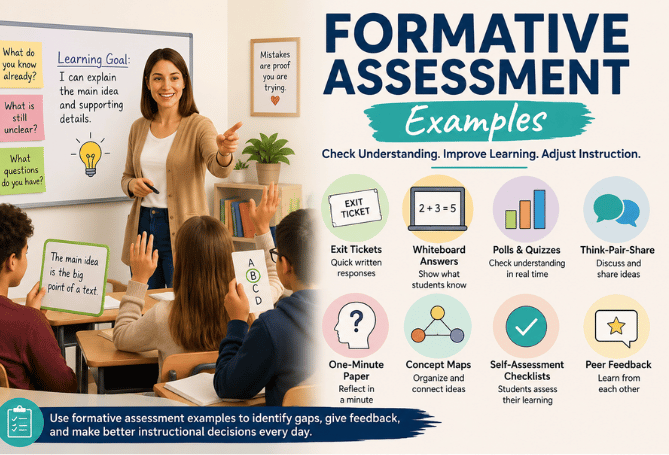
Examples include exit tickets, quick quizzes, classroom polls, think-pair-share activities, mini whiteboards, concept maps, and self-assessment checklists.
What Makes an Assessment Formative?
A classroom activity is not formative simply because it is short or ungraded. Its purpose is to produce evidence that guides the next learning decision.
For example, a teacher might ask five multiple-choice questions at the end of a lesson. If the scores are recorded and the class immediately moves to a new topic, the quiz has done little to shape learning. If the teacher examines the answers, identifies a shared misconception, and changes the next lesson, the same quiz becomes useful assessment evidence.
Researchers commonly describe the process as gathering, interpreting, and using evidence to make better instructional decisions. This can involve decisions made by teachers, students, or classmates. OOM checks usually have four parts:
- A clear learning goal
- A task that reveals student thinking
- A quick way to interpret the responses
- A planned action based on the results
25 Formative Assessment Examples For The Classroom

The best technique depends on what you need to discover. Some activities reveal prior knowledge. Others uncover misconceptions, test recall, or help students evaluate their own progress.
Entry Tickets
Give students one question as they enter the classroom. The prompt can review yesterday’s lesson or introduce today’s topic. A history teacher might ask, “What was one cause of the Industrial Revolution?” A mathematics teacher might display a fraction problem. Scan the responses before direct instruction and adjust the opening activity.
Exit Tickets
Ask students to answer one to three questions before leaving. Keep the prompts closely tied to the day’s learning goal.
Useful exit-ticket prompts include:
- What is the most important idea from today?
- Which part still feels unclear?
- Solve this problem and explain one step.
- What question should we revisit tomorrow?
Exit tickets are common because they require little preparation and provide timely evidence. Whiteboards: Students write an answer on individual boards and reveal it at the same time. This lets you check the whole class rather than hearing only from volunteers.
Ask students to show calculations, label a diagram, correct a sentence, or write a one-word response. Follow the activity with feedback and another chance to answer. That second attempt shows whether the feedback helped. o Five
Students hold up zero to five fingers to show their confidence or understanding.
Use a clear scale:
- Zero: I am lost.
- One or two: I need more help.
- Three: I understand part of it.
- Four: I can complete the task.
- Five: I can explain it to someone else.
Treat the signals as a starting point. Ask a few follow-up questions because confidence does not always equal mastery.
Think-Pair-Share
Ask a question and give students quiet thinking time. Students then discuss their response with a partner before sharing with the class. Walk around and listen for reasoning, vocabulary, and misconceptions. The conversations often reveal more than a simple show of hands.
One-Minute Paper
Give students sixty seconds to explain a concept in writing. The tight time limit encourages concise thinking.
Prompts might include:
- Explain photosynthesis in two sentences.
- Describe the author’s main argument.
- Name one difference between mass and weight.
Review several responses aloud or sort them into understanding levels.
Low-Stakes Quizzes
Use a short quiz to test recall, application, or misconceptions. Keep the grade impact low so the activity supports learning rather than anxiety. Provide quick feedback and let students correct their answers. Online quizzes can display patterns instantly, while paper quizzes may make written reasoning easier to review.
Multiple-Choice Polls
Display a question with several plausible answers. Ask everyone to respond through cards, hand signals, a polling platform, or classroom devices. Good incorrect options should represent common errors. A split response tells you that the class needs discussion, explanation, or another example.
Diagnostic Questions
A diagnostic question is designed around a specific misunderstanding. For instance, instead of asking students to calculate a negative-number problem, ask them which solution is correct and why. Their choice helps you identify the exact rule they are applying incorrectly.
Concept Maps
Students draw connections between key terms, processes, or ideas. The finished map shows how they organize knowledge. Concept maps work well before a unit to reveal prior knowledge and after instruction to show how connections have developed.
Misconception Check
Present a statement that sounds reasonable but is incorrect. Ask students whether they agree and require an explanation.
Examples include:
- Heavier objects always fall faster.
- A larger denominator means a larger fraction.
- Every character’s statement reflects the author’s view.
The explanations matter more than the vote.
Error Analysis
Show a completed response that contains a mistake. Ask students to locate the error, explain why it occurred, and correct it. This method reveals whether learners understand the process rather than merely recognizing the final answer.
Example and Non-Example
Give one item that fits a concept and another that does not. Students identify the defining difference. In language arts, compare a complete sentence with a fragment. In science, compare a physical change with a chemical change. In mathematics, compare proportional and non-proportional relationships.
Four Corners
Label four areas of the room with possible answers, opinions, or confidence levels. Students move to the corner, matching their response. Ask representatives from each group to explain their reasoning. Students can change corners after hearing the discussion, making shifts in understanding visible.
Quick Draw
Ask students to represent an idea with a sketch, diagram, model, or labeled image. This works well for systems, cycles, spatial relationships, and sequences. It also gives students another way to communicate when a written explanation may hide what they understand.
Student Demonstrations
Invite students to perform a process while explaining each choice. A learner might solve an equation, use laboratory equipment, pronounce a phrase, demonstrate a sports technique, or show how to format a document. Use a short checklist to record what the student can do independently.
Oral Questioning
Plan questions that move from recall to explanation and application. Avoid relying only on volunteers. Give everyone thinking time before selecting a student. Ask follow-up questions such as “What evidence supports that?” or “How did you decide?” These prompts make student reasoning visible.
Traffic-Light Cards
Students display green, yellow, or red cards.
- Green means ready to continue.
- Yellow means partly confident.
- Red means help is needed.
Pair the colors with a written problem or explanation. This prevents the activity from becoming a confidence survey with no evidence.
Peer Feedback
Students review a classmate’s work using clear success criteria. Limit the task to one or two features. For example, students might check whether a paragraph includes evidence and an explanation. They should offer a specific comment rather than a general judgment.
Self-Assessment Checklist
Give students a checklist linked to the learning goal. Ask them to mark what they can do and provide evidence.
A writing checklist might include:
- I stated a clear claim.
- I used relevant evidence.
- I explained how the evidence supports my claim.
- I revised unclear sentences.
Self-assessment is stronger when students must point to an example in their work.
Two Stars and a Wish
Students identify two successful features and one area for improvement. Teach them to connect each comment to a criterion. “Your second example supports the claim” is more useful than “Good work.”
Retrieval Grid
Create a grid of questions covering recent and older material. Students answer as many as possible without notes. Use their responses to spot knowledge that is fading. Revisit weak areas through practice rather than repeating the entire lesson.
Students looking for independent learning methods can explore Thinkomics’ developing collection of student guides.
Muddiest Point
Ask students to identify the most confusing part of the lesson.
Students may submit their answer anonymously. Group similar responses and address the most common issue at the start of the next lesson.
Headline Summary
Ask students to write a newspaper-style headline summarizing the main idea. A strong headline requires students to identify what matters most. Follow it with a sentence explaining why they chose that wording.
Teach It to a Partner
Pair students and ask each learner to explain a concept, process, or solution. The listener uses a checklist or asks one follow-up question. Switch roles so that both students can explain. Listen for missing steps and inaccurate vocabulary.
How to Choose the Right Classroom Check

Do not choose an activity because it looks engaging. Start with the decision you need to make.
| What you need to know | Suitable options |
| What students already know | Entry ticket, concept map, diagnostic question |
| Whether the class can continue | Mini whiteboards, polls, traffic lights |
| Why are students making errors | Error analysis, oral questioning, and misconception check |
| Whether students can explain ideas | Think-pair-share, one-minute paper, partner teaching |
| Whether students can perform a skill | Demonstration, quick draw, worked problem |
| Whether students can judge quality | Peer feedback, self-assessment, checklist |
| What to revisit tomorrow | Exit ticket, muddiest point, retrieval grid |
Teachers working in virtual or blended settings can adapt many of these techniques with forms, polls, discussion boards, shared documents, and video responses. Thinkomics’ online learning section provides a natural home for related digital-teaching resources.
What Should Teachers Do with Results?
Collecting responses is only the first half of the process. The value comes from the next action.
After reviewing the evidence, you might:
- Reteach the idea using a different representation.
- Give a small group extra guided practice.
- Pair students for peer explanation.
- Provide an extension task to students who are ready.
- Correct a widespread misconception.
- Slow down or shorten the next activity.
- Give feedback and allow another attempt.
Set simple response rules before the lesson. For example, if fewer than half the students answer correctly, reteach the concept. If most understand but several remain unsure, use a short, small-group activity. If nearly everyone succeeds, move to the application. This prevents assessment from creating piles of information that never affect teaching.
Common Mistakes to Avoid

Using Only Volunteers
Confident students can make the class appear more secure than it is. Use methods that collect a response from everyone.
Asking Questions That Are Too Easy
A recall question cannot show whether students can analyze, explain, or apply an idea. Match the prompt to the learning goal.
Treating Confidence as Proof
Thumbs, colors, and rating scales are quick, but students may misjudge their own understanding. Pair confidence signals with a short task.
Giving Feedback Without Revision
Comments have limited value when students never use them. Build in time to correct, retry, or improve the work.
Collecting More Data Than You Can Use
A three-question check may be more useful than a twenty-question quiz. Gather enough evidence to make the next decision, then act.
Conclusion
Formative assessment examples are valuable tools that help teachers monitor student understanding throughout the learning process instead of waiting until the end of a unit. By using quick classroom checks such as exit tickets, quizzes, concept maps, peer feedback, and self-assessments, educators can identify learning gaps, provide timely feedback, and adjust instruction to meet students’ needs. We cover this in more depth in Performance Assessment.
The most effective formative assessment examples focus on improving learning rather than assigning grades, creating a classroom environment where students can build confidence, correct mistakes, and make steady academic progress. When used consistently, these strategies lead to stronger engagement, better instructional decisions, and improved student achievement. For a closer look at this, see What are examples of effective team dynamics.
Apart from that, if you want to know about the article Fun Icebreaker Questions, then please visit our Education Category.
Frequently Asked Questions
Exit tickets, mini whiteboards, polls, diagnostic questions, and one-minute papers are strong choices. They take little time and can produce class-wide evidence. Choose the method that reveals the skill or misconception connected to your learning goal.
A formative check guides learning while instruction is still happening. A summative assessment evaluates achievement after a period of learning, such as at the end of a unit or course. The same format can serve either purpose. A quiz used to adjust tomorrow’s lesson is formative. A quiz used only to calculate a final grade is summative.
It is usually ungraded or given little weight. Low-stakes conditions encourage students to reveal confusion and take productive risks. Teachers may still record completion, progress, or feedback when appropriate.
Use them when the evidence can guide a real decision. A brief check may fit several points in one lesson, while a longer reflection may be appropriate once a week. Frequency matters less than whether the results lead to action.
Use them when the evidence can guide a real decision. A brief check may fit several points in one lesson, while a longer reflection may be appropriate once a week. Frequency matters less than whether the results lead to action.
Yes. Retrieval questions, error analysis, self-assessment, and low-stakes quizzes help learners identify gaps before a final test. Students can find more study-related material in Thinkomics’ exam resources.