

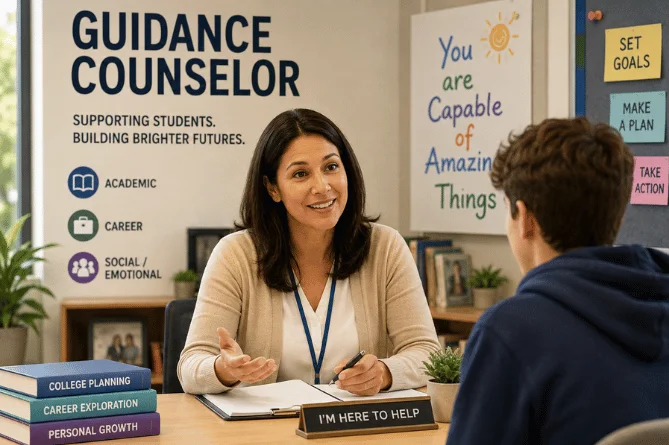
A guidance counselor supports students with academic planning, career decisions, school adjustment, social challenges, and short-term emotional needs. Today, “school counselor” is the preferred professional title. The role can include individual support, group work, collaboration with families and teachers, referrals, and schoolwide programs that help students succeed. The pay figure covers the broader BLS category of school and career counselors and advisors, rather than school counselors alone. Requirements also vary by state.
| Guidance Counselor | What to know |
| Preferred professional title | School counselor |
| Main areas of support | Academic, career, and social/emotional development |
| Typical U.S. education | Master’s degree in school counseling or a related field |
| Public-school credential | State-issued certification, license, or endorsement |
| Median annual pay | $65,140 for the BLS occupational group in May 2024 |
| Employment outlook | 4% growth from 2024 to 2034 |
| Projected openings | About 31,000 per year |
| Student-to-counselor ratio | 372:1 nationally in 2024–25; ASCA recommends 250:1 |
What Does a Guidance Counselor Do?

The job reaches far beyond choosing classes or filling out college applications. School counselors help students address problems that can affect learning, attendance, behavior, relationships, and plans after graduation.
Typical responsibilities can include:
- helping students improve study and time-management habits
- discussing academic goals and course choices
- exploring occupations, colleges, training programs, and other postsecondary options
- supporting students through social or behavioral challenges
- meeting with individuals and small groups
- working with teachers and families on student goals
- referring students and parents to other resources when more support is needed
ASCA organizes school counseling around three connected areas: academic, career, and social/emotional development. A comprehensive program addresses all three rather than treating counseling as college planning alone.
Why “Guidance Counselor” Is Now the Preferred Title
The older professional label remains common in everyday searches, job postings, and conversation. Professional organizations have moved toward school counselors because the modern role covers much more than giving students academic or vocational “guidance.”
ASCA has specifically argued that using the two titles interchangeably can create confusion about the scope and competencies of the profession. Its resources describe counselors as professionals who design and deliver programs tied to academic achievement, career preparation, and social/emotional growth.
That distinction matters for students and parents. Your counselor may be able to help with concerns you would not immediately associate with course scheduling.
How the Work Changes by Grade Level
A counselor’s priorities change as students grow. BLS describes distinct areas of emphasis across elementary, middle, and high school.
| School level | Common areas of focus |
| Elementary | Social skills, learning habits, adjustment, strengths, challenges, and family collaboration |
| Middle school | Decision-making, study habits, relationships, personal challenges, and transition to high school |
| High school | Course planning, graduation, college, training, financial aid, careers, internships, and apprenticeships |
Social and emotional development remains relevant at every stage. Younger students may need help naming and communicating feelings. Thinkomics Math Enrichment provides a simple resource for building that vocabulary.
When Should Students or Families Contact the Counselor?
You don’t need to wait for a crisis. A school counselor can be useful when a student faces a decision, barrier, transition, or concern that affects school life.
Consider reaching out when:
- grades or attendance change unexpectedly
- a student struggles with organization or study habits
- friendships, bullying, or school adjustment become difficult
- course choices or graduation requirements feel confusing
- college, training, or career options seem overwhelming
- family circumstances begin affecting school performance
- a student needs help finding additional school or community support
For students weighing career options, developing How to Improve Your Vocabulary and Turn New Words Into Everyday Language can make comparisons more thoughtful. They can also use Thinkomics’ overview as a starting point for career research, then discuss realistic education requirements with their counselor.
What School Counselors Can and Cannot Do

Counselors can provide direct support inside a school setting. They may meet individually with students, lead groups, teach classroom lessons, consult with families, and coordinate with teachers or administrators.
Their role also includes knowing when another service is appropriate. BLS lists referrals to additional resources among common responsibilities. ASCA likewise describes referrals, consultation, and collaboration as parts of school counseling programs.
So a counselor can be an important first contact for emotional or behavioral concerns, but some students may need services beyond what their school provides. The appropriate next step depends on the student’s needs and available local resources.
How to Become a School Counselor
The exact requirements depend on the state, so prospective counselors should check the education agency or licensing authority where they plan to work.
A common U.S. route looks like this:
- Earn a bachelor’s degree. Your undergraduate major does not always need to be school counseling.
- Complete an appropriate master’s program. Most school counselors need a master’s degree in school counseling or a related subject.
- Complete supervised field experience. Graduate programs commonly include a practicum or internship.
- Meet state testing and background requirements. Rules differ across jurisdictions.
- Apply for the required state credential. The credential may be called a certification, license, or endorsement.
BLS says nearly all states and the District of Columbia require school counselors to hold a master’s degree. Public-school counselors must also hold a state-issued credential. Typical credentialing requirements include graduate education, supervised experience, and an examination. Because requirements differ, don’t choose a graduate program based only on its name. First confirm that its curriculum and fieldwork meet the rules in the state where you intend to practice.
Salary, Job Outlook, and the Caseload Reality

BLS reports a $65,140 median annual wage in May 2024 for its combined category of school and career counselors and advisors. Workers in local elementary and secondary schools had a median wage of $76,960. Pay varies by location, employer, experience, contract structure, and school type.
Employment in the combined occupation is projected to grow 4% from 2024 through 2034. BLS expects about 31,000 openings each year on average, including openings created when workers leave the occupation or retire.
Caseload is another part of the job worth understanding. ASCA reports a national student-to-school-counselor ratio of 372 students per counselor for 2024–25, compared with its recommended ratio of 250:1. That means access and workload can differ substantially between schools.
For someone considering this career, salary tells only part of the story. Ask prospective employers about caseload, assigned duties, administrative responsibilities, program structure, supervision, and the amount of time available for direct student services.
Conclusion
A guidance counselor does far more than help students choose classes or prepare for college. The profession combines academic planning, career development, social and emotional support, collaboration with families and teachers, and referrals to additional resources when needed.
For students and parents, understanding when to contact a counselor can make it easier to address challenges before they become larger barriers. For those considering this career, the path typically requires graduate education, supervised experience, and state-specific credentials. Ultimately, school counseling offers a meaningful way to support students while helping them build the skills, confidence, and plans needed for life beyond school.
Your Next Step
If you’re a student or parent, find the counselor’s contact information through your school and request a conversation about the specific issue you want to solve. Bringing a short list of questions can make that meeting more productive.
If you’re considering the profession as a career, start with your state’s credential requirements. Then compare accredited or state-approved graduate programs, supervised-experience requirements, costs, and local job opportunities before choosing a path.
Frequently Asked Questions
The terms may refer to the same position in everyday use, but “school counselor” is the preferred modern professional title. ASCA argues that the newer title better reflects a role covering academic, career, and social/emotional development rather than guidance alone.
Yes, within the scope of school counseling. ASCA identifies social/emotional development as one of the profession’s three main domains. Counselors can provide school-based support, collaborate with families and staff, and make referrals when students need additional services.
In the United States, most do. BLS says nearly all states and the District of Columbia require a master’s degree for school counselors. Public-school counselors also need the state credential required where they practice.
BLS reports a May 2024 median of $65,140 for the combined occupation of school and career counselors and advisors. The median for workers in local elementary and secondary schools was $76,960. Local salaries can differ considerably.
No. College and career planning is one part of the work, especially at the high school level. Academic development and social/emotional support are also central parts of modern school counseling.

