

Virtual science teachers deliver science instruction remotely, through live video lessons, simulated labs, and work students finish on their own. Most hold the same state license as a classroom teacher. The job has three parts: teaching content, running investigations, and testing how students reason. That last part decides whether the format works.
A student can watch a titration on video and still have no idea why the color changed. Good online teaching fixes that by making students commit to an answer first.
| Article overview | Detail |
| Who does this job | Licensed teachers employed by online schools, districts, staffing providers, or tutoring companies |
| Grade levels | Mostly high school, where online course offerings concentrate |
| Typical subjects | Biology, chemistry, physics, earth and space science, environmental science |
| Lab approach | Simulations, remote-access instruments, mailed home kits, or a mix of all three |
| US median pay, related role | $64,580 for high school teachers, May 2024 (Bureau of Labor Statistics) |
| Evidence on virtual labs | No measured advantage for either physical or virtual investigation (2023 meta-analysis) |
| Biggest failure point | Narrating a demonstration instead of making students predict and defend |
Key takeaways
- A simulation is not automatically a downgrade. Pooled research finds no reliable gap in concept learning between physical and virtual investigation.
- Live science time is best spent on prediction, argument, and error hunting. Save the lecture for a recording students can pause.
- Home kits and off-screen fieldwork close the gap simulations leave open: handling equipment, making a mess, and facing a result that refuses to cooperate.
- Schools hire these teachers three ways: direct posting, a staffing provider, or shared teaching across districts.
- The licensing question, not the technology question, is what usually stalls a hire.
What the job looks like on a school day
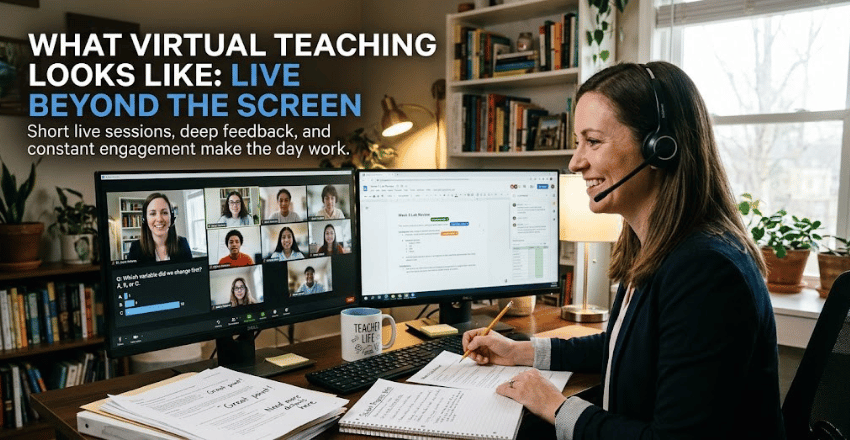
Nobody spends six hours a day on video. Most run two or three live sessions, then spend the rest of the day on feedback, small-group help, lab review, and messages home. Live blocks stay short on purpose, often 40 to 55 minutes. Attention on a screen runs out faster than attention in a room.
Lesson design shifts, too. In a physical classroom, a teacher reads confusion off thirty faces. Online, that signal vanishes. So the teacher has to build it back in. Polls every few minutes, a shared document everyone types into, a quick sketch of what students expect before the simulation.
The structure around the lesson matters as much as the lesson. Our breakdown of what a virtual school program involves covers attendance and records, plus who owns each responsibility.
Do virtual labs teach as well as the real bench?
This is the question every science department asks first, and the honest answer is more encouraging than most teachers expect.
A 2023 meta-analysis by Muilwijk and Lazonder pooled 35 studies covering 3,303 participants. Writing in Frontiers in Education, they found no overall advantage for either mode of investigation (g = -0.14, 95% CI -0.33 to 0.06). The gap sits close enough to zero that neither format wins on concepts.
Moderators are where it gets interesting. Virtual work suited adults better than children, and suited any concept where touch did not matter. A simulation of orbital mechanics loses nothing. Viscosity and dissection lose a great deal.
| Approach | Strongest for | Weakest for | Cost to a school |
| Simulation | Invisible or dangerous processes, repeated trials, fast variable changes | Equipment handling, measurement error, messy real data | Low, many free options |
| Mailed home kit | Technique, safety habits, genuine unexpected results | Shipping delays, supervision, consumables that run out | Roughly $25 to $90 per student per course |
| Remote-access instrument | Real data from real hardware, telescopes and sensors | Scheduling, queueing, limited experiment choice | Often free through university programs |
| Recorded demonstration | Modeling a procedure before students try it | Everything else, students stay passive | Low |
The tools virtual science teachers rely on
Most of the useful ones are free, and the free ones are often better than the paid ones.
- PhET Interactive Simulations from the University of Colorado Boulder, still the reference set for physics and chemistry concepts.
- Data-collection platforms that let a whole class pool measurements into one live spreadsheet, so students argue about spread instead of copying a single number.
- Subscription lab suites such as Labster or Gizmos, worth the money mainly when a course needs assessment data attached to each lab.
- Annotation and modeling boards where students draw a mechanism, then revise the drawing after the evidence arrives.
- Remote telescope and sensor networks run by universities and national observatories.
Tool choice matters less than sequence. Open a simulation before students commit to a prediction and you have entertainment, not investigation.
Eight moves that make an online science lesson land
- Open with a phenomenon, not an objective. Show something odd and ask what could explain it.
- Collect a written prediction from every student before the demonstration starts.
- Keep the direct explanation under eight minutes, then hand control back.
- Give students the raw data rather than the conclusion, and let them find the pattern.
- Build in one deliberate wrong answer per lesson and ask the class to find the flaw.
- Check understanding mid-lesson rather than at the end. Our list of quick formative assessment ideas adapts almost directly to a video call.
- Offer a task menu for the practice stage. A choice board menu for student agency lets one student model the reaction while another writes the explanation, against the same objective.
- Close by asking what would change the answer. That single question separates recall from scientific reasoning.
Home kits, safety, and the off-screen half
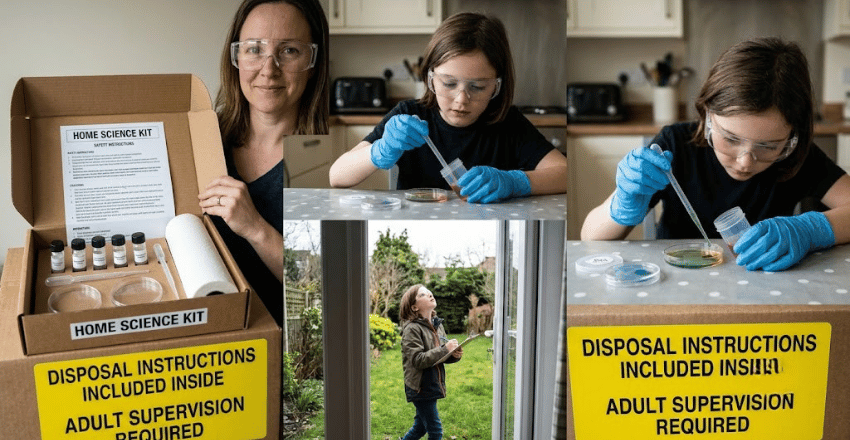
Screens cannot teach a student to hold a pipette. Schools that take online science seriously ship physical materials, usually a sealed kit with consumables, safety glasses, and a printed hazard sheet for the adult at home.
Three rules keep this workable. Anything that produces fumes, sustained heat, or a corrosive stays in the simulation. Every kit lists the adult supervision each activity needs. And the disposal instructions ship with the kit, not as a link.
Fieldwork is the cheaper half of the same idea, and it needs no kit at all. Students measuring shade temperature, counting pollinators, or logging cloud cover are collecting real data. Our guide to outdoor activities that teach kids about nature works well as a source of assignments for younger grades.
How schools hire and keep remote science staff
Districts fill these roles three ways. They post directly and hire a licensed teacher who works from home. They contract a staffing provider that supplies a certified teacher into a room where a local paraprofessional supervises students. Or several small districts share one teacher across a video link.
The second route moves fastest and hides the most detail, so ask a provider these before signing:
- Which state licenses does the assigned teacher actually hold, and does that cover this course code?
- Who supplies and replaces lab consumables, and on what schedule?
- What happens on the day the teacher is sick?
- Who owns the gradebook, the recordings, and the student data?
- How many other sections is this teacher carrying at the same time?
Scheduling decides the rest. Live discussion and independent work need different staffing. Our comparison of synchronous and asynchronous learning formats is a useful check before you write the job description.
Becoming one: the path and the pay
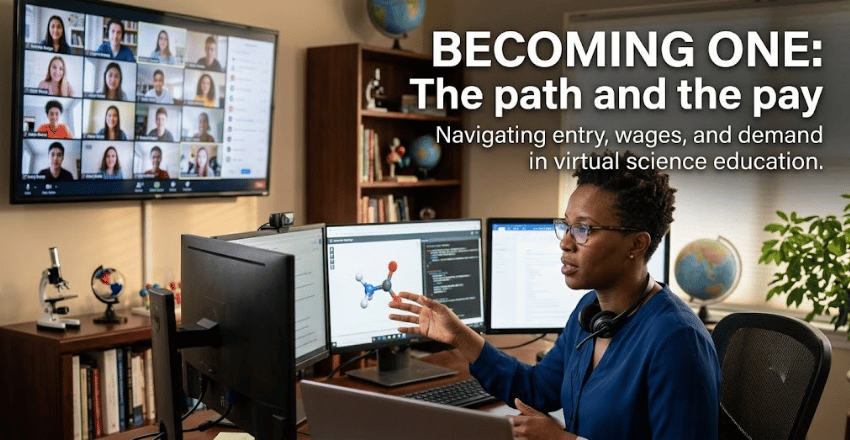
Entry requirements mirror the classroom. You need a bachelor’s degree, a state teaching license with a science endorsement, and in most cases some in-person experience first. Employers care about two extra things: whether you can hold a room you cannot see, and whether you have run a lab remotely before.
Pay tracks the classroom, not the technology. The Bureau of Labor Statistics puts the median wage for high school teachers at $64,580 in May 2024. It projects a 2 percent drop in those jobs from 2024 to 2034, with roughly 66,200 openings a year. Tutoring firms pay by the hour instead, and rates swing widely by subject and state.
Demand sits where the courses are. In the 2017-18 school year, 58.9 percent of US public high schools offered at least one course entirely online. Only 12.7 percent of middle schools and 2.7 percent of primary schools did, according to the National Center for Education Statistics. Chemistry and physics licenses are scarcest, so they travel best across district lines.
Your next step
Pick one unit you already teach and rebuild a single lesson around a prediction, a simulation, and one question about what would change the answer. Run it live, and watch how much the talk time drops. That one lesson tells you more about online science teaching than a semester of platform demos.
Conclusion
Virtual science teachers have shown that effective science instruction is not defined by a physical classroom but by thoughtful lesson design. Research indicates that well-planned virtual labs can build conceptual understanding as effectively as traditional laboratory work, provided students actively predict, investigate, and explain rather than simply watching demonstrations. The technology supports learning, but the teacher’s ability to guide scientific reasoning remains the deciding factor.
Schools considering online science programs should prioritize licensed educators, clear lab safety procedures, and a balanced mix of simulations, home investigations, and live discussion. For teachers entering the field, success comes from designing lessons that encourage curiosity, evidence-based thinking, and meaningful student participation. When implemented well, virtual science teaching expands access to high-quality STEM education while preserving the inquiry and critical thinking that define science itself.
If you want to know about Synchronous vs Asynchronous Learning, then visit our Online learning category.
Frequently asked questions
Virtual science means running an investigation through digital models and simulated equipment instead of real apparatus. Students still control variables, take measurements, and read the results. They lose the physical handling. They gain speed, safety, and a view of processes too slow, too small, or too risky for a school lab.
It is software that models a real experiment closely enough to run it, change the conditions, and get data that behaves like measured data. Good ones include error and variation. Weak ones return a clean textbook answer every time. That quietly teaches students that science always cooperates.
On conceptual learning, the research finds no reliable gap between virtual and physical investigation. Effectiveness depends far more on how the lesson is built than on where it happens. The teachers who struggle online are usually the ones who moved a lecture onto video without changing anything else about it.
Give them something to do every few minutes: predict, vote, sketch, type a claim, challenge someone else’s reasoning. Engagement online is a design problem, not a personality problem. A silent call usually means the lesson gave students nothing to respond to.
Yes, within limits. Kitchen chemistry, plant growth trials, pendulum timing, sound and light investigations, and outdoor data collection all work with household materials. Anything involving strong acids, sustained flame, or pressurized gas belongs in a simulation or a supervised campus lab day.
A bachelor’s degree, a state license with a science endorsement, and a background check are the baseline for school roles. Tutoring and enrichment providers set their own bars, which are often lower. Multi-state licensure is the single biggest advantage on an application.