
Pick the self-paced version when schedules collide. Pick the live version when the learning depends on people talking to each other. That one rule settles most of the synchronous vs asynchronous learning question. The evidence backs it up, because the measured gap in test scores between the two formats is small.
| Question | Short answer |
| Which format scores higher on tests? | Live, by a small margin (g = 0.37 in a 2021 meta-analysis) |
| Which is faster to build? | Live. You teach it once, in real time |
| Which is cheaper to run again? | Self-paced, after the first build is paid for |
| Typical student load, one 3-credit course | About 9 hours a week either way |
| Which needs real-time captions? | Live sessions, under WCAG 2.1 criterion 1.2.4 |
| Best fit for working adults | Self-paced, with a few live checkpoints |
| Best fit for debate, labs and language practice | Live |
| What most real courses do | Mix both, on purpose |
Key takeaways
- The achievement difference between the two formats is small, and the research disagrees on its direction.
- Cost, time zones, and captioning duty are the factors that actually change your answer.
- Self-paced is expensive to build once and cheap forever after. Live is the reverse.
- Self-paced does not mean deadline-free. Courses that drop deadlines lose students.
- The seven checks near the end of this guide give you a score and a decision.
The short answer, and what the research says
Synchronous learning happens live on a set schedule. Asynchronous learning happens on the student’s own clock, through recordings, readings, quizzes, and discussion boards. Live sessions win slightly on test scores and clearly on discussion. Self-paced wins on access, cost, and flexibility. Most strong courses use both, and save live time for work that needs other people.
Research is calmer than the marketing. Back in 2021, a meta-analysis in the International Review of Research in Open and Distributed Learning pooled seven studies that compared the two formats on test scores. Martin and colleagues found live instruction ahead by a small margin, g = 0.37, with a 95% confidence interval running from 0.055 to 0.679. That lower bound sits close to zero.
Now flip it. A 2024 meta-analysis in Interactive Learning Environments pooled 14 studies and found the self-paced format slightly ahead, then called the effect trivial. Two careful reviews, two directions, one shared conclusion: the format is not what decides whether students learn.
One more number is worth knowing before you choose. According to the National Center for Education Statistics, 9.4 million students, or 61 percent of all US undergraduates, took at least one distance education course in fall 2021. Of that group, 4.4 million took every course that way.
What each format actually is

Live and scheduled
Everyone joins at the same time. A video meeting, a chat-based seminar, a webinar with breakout rooms, a live coding session. The instructor can read the room, change direction, and answer a confused question in ten seconds instead of ten hours.
Recorded and self-paced
Students work through the same material on their own schedule. Recorded lectures, readings, quizzes, threaded discussions, submitted projects. Nothing requires two people to be awake at once.
Blended, sometimes called bichronous
Content is recorded, and live time is reserved for the things recordings cannot do: critique, practice, questions, group decisions. This is what most well-run online programs settle on, and the delivery clock matters less than the method. The same teaching strategies that fit the lesson goal apply whether the class is live or recorded.
Synchronous vs asynchronous learning at a glance
| Factor | Live | Self-paced | Blended |
| Schedule | Fixed times | Any time | Few fixed points |
| Feedback speed | Seconds | Hours to days | Mixed |
| Build cost | Low | High | Medium |
| Cost to run again | Same every time | Close to zero | Low |
| Class size that works | Under 30 | Almost unlimited | Under 100 |
| Caption duty | Real time, every session | Once per video | Both |
| Where it breaks | Time zones, sick days, shy students | Motivation, isolation, cheating | Instructor workload |
| Strongest fit | Discussion, labs, language | Reference, compliance, theory | Degree programs |
Pros and cons of each format
Live sessions give you speed and accountability. They also give you a hard scheduling problem.
- Pros: instant answers, real discussion, visible attendance, natural peer bonds, easier to keep honest.
- Cons: time zone conflicts, no replay unless you record, sick days become missed days, quiet students stay quiet.
Self-paced courses give you reach. They also hand the student a job that many students are not ready for.
- Pros: works around shift work and childcare, replayable, scales to thousands, cheaper per learner over time.
- Cons: slow feedback, weak accountability, thin social contact, higher drop-off, harder to police assessments.
The hours and dollars nobody counts

Student time is roughly equal. Expect about 9 hours a week from a US 3-credit course in either format, so flexibility is the real difference, not workload.
Instructor time is not equal at all. Preparing a one-hour live session takes a couple of hours. One finished hour of recorded material takes days, because someone has to script it, record it, edit it, quiz it, and caption it.
Captioning is where the invoice shows up. Utah State University publishes a standard rate of $1.20 per video minute. That puts a single 50-minute recorded lecture at about $60, and a 24-hour course library past $1,700. You pay it once. Live captioning is billed per session, every term, forever.
Feedback carries a cost too. In a self-paced course, every check for understanding has to be written, automated, or graded later. Lean on fast formative assessment checks that a learning platform can score without you.
Captions and access change the build
US accessibility rules treat the two formats differently, and almost no comparison guide mentions it. The Department of Justice rule for state and local government web content adopts WCAG 2.1 Level AA, the standard the World Wide Web Consortium published in 2018. Under those criteria, captions for prerecorded audio sit at Level A, and captions for live audio sit one step higher at Level AA.
Read plainly: a recorded lecture needs captions, and a live class needs them in real time. Public institutions face compliance dates of April 26, 2027 for entities serving 50,000 or more people, and April 26, 2028 for smaller ones. Budget for it before you choose a format, not after.
Time zones and the deadline trap
Run the clock math before you promise live sessions. A 7 p.m. Eastern class is 4 p.m. Pacific, which is still a workday for many students. Add Alaska or a deployed service member, and no hour works for everyone. Three time zones is usually the practical ceiling for one live section.
Trap number two is quieter. Self-paced is not deadline-free. Courses that remove every due date see work pile up and students disappear in week six. Keep weekly checkpoints, keep them small, and give students a real choice about which task they do. Offering a choice board of tasks preserves the flexibility without removing the structure.
What breaks in each format
Live classes break on absence and on temperament. Miss the session, and you miss the course, unless you record it. Quiet students often say nothing for a whole term. Written threads let them think first and answer well, which is one reason discussion boards can sharpen critical thinking more than a fast-moving call.
Self-paced courses break on connection and on integrity. Students who never meet a classmate treat the course as a chore, and unproctored quizzes invite shortcuts. Short live check-ins and deliberate activities that build social-emotional skills fix more of that than another policy paragraph.
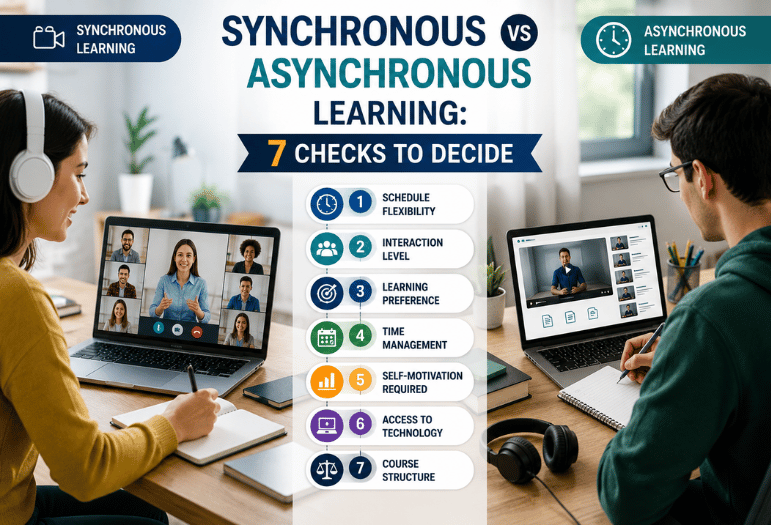
7 checks that decide it for you

Score each check. One point for live, one for self-paced. Highest total wins, and a tie means blended.
- Time zones. Within three zones, score live. Wider, score self-paced.
- Cohort size. Under 30 favors live. Over 100 favors self-paced.
- Repeat runs. Teaching it once favors live. Running it every quarter favors self-paced.
- Skill type. Debate, speaking, critique, and lab work favor live. Facts and procedures favor self-paced.
- Student life. Shift workers and parents favor self-paced. Full-time students favor live.
- Assessment stakes. High-stakes grading without proctoring favors live.
- Budget shape. Money now and little later favors self-paced. Steady small budgets favor live.
The verdict
Our pick for most courses is blended, weighted toward self-paced. Record the content, because recordings are replayable, captionable once, and kind to every schedule. Then buy back the one thing recordings cannot deliver with a short live session each week, ideally 45 minutes of questions, critique, and practice rather than a lecture repeat.
Choose fully live only when the skill is social by nature, or when the cohort is small and sits in one or two time zones. Choose fully self-paced when the audience is scattered, the content is stable, and you will run the course many times. If reading load is heavy for younger learners, check that reading fluency support is in place before you hand them a text-only module.
Your next step
Run the seven checks against your own course this week and write down the score. Then build the format that wins, add one live checkpoint if the total was close, and put the captioning cost in the budget before term one starts.
FAQ
No. Both are usually online, and both can happen in a building. The split is about timing, not place.
Live sections generally finish stronger, mostly because attendance creates accountability. Well-designed self-paced courses close that gap with weekly deadlines and quick instructor contact.
Rarely in a graded program, since the assessment design differs. Corporate training switches more freely, because the outcome is competence rather than credit.
Between 45 and 60 minutes for adults, and 20 to 30 minutes for younger students. Anything longer works better as a recording.
Any video tool plus a learning platform covers both. Your captioning workflow matters more than the brand you pick.