

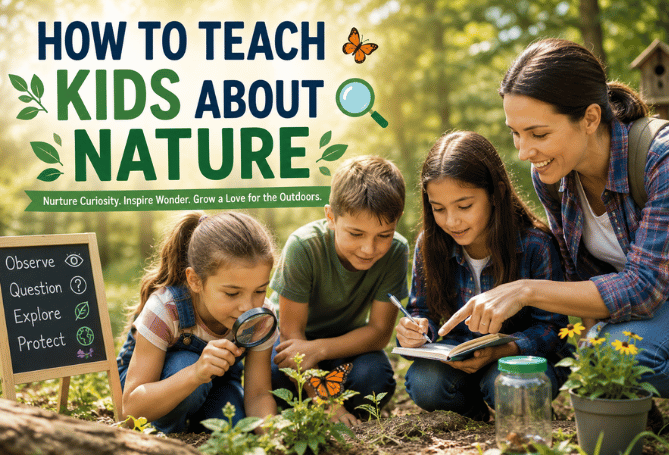
Learning how to teach kids about nature doesn’t require a distant forest, expensive equipment, or expert knowledge. Begin with a nearby outdoor space and let children observe, ask questions, collect safe objects, and notice seasonal changes. Short, repeated experiences often build more curiosity than a single, highly planned trip.
Children can explore nature in a garden, playground, schoolyard, balcony, neighborhood, or local park. Your main role is to create opportunities, model careful observation, and help them investigate their own questions.
| How to Teach Kids About Nature | Practical guidance |
| Best starting place | A familiar garden, street, park, or schoolyard |
| Useful session length | 15–30 minutes for younger children |
| Basic materials | Notebook, pencil, magnifier, reusable container |
| Main teaching method | Observe, question, investigate, and reflect |
| Suitable ages | Preschool through middle school |
| Adult role | Guide attention without controlling every discovery |
| Safety priority | Supervision, boundaries, weather, and safe handling |
What You’ll Need
Most nature lessons need only a few basic items:
- A notebook or several sheets of paper
- Pencils, crayons, or colored pencils
- A child-safe magnifying glass
- A small ruler
- Reusable bags or containers for permitted objects
- Weather-appropriate clothing
- Water and sun protection
- A local field guide or identification app
Technology can support an investigation, but it shouldn’t replace direct observation. One study of families using a nature-exploration app found that technology could encourage outdoor discovery when it supported shared experiences rather than distracting from them.
How to Teach Kids About Nature in 9 Steps
1. Begin With a Familiar Outdoor Place
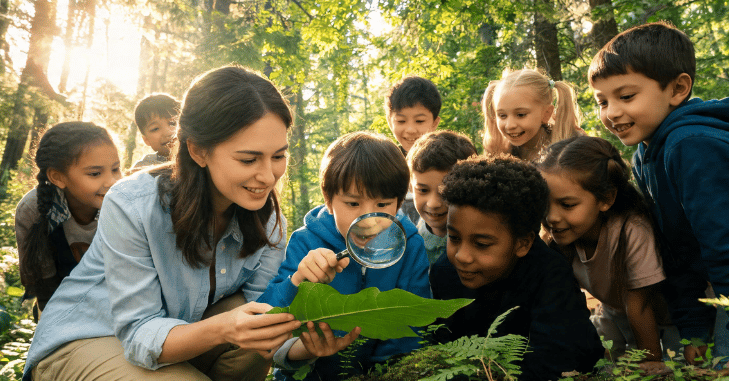
Choose somewhere easy to revisit. It could be a backyard, apartment courtyard, school garden, sidewalk, or small public park. A familiar location helps children notice change. On the first visit, they may see only trees and grass. After several visits, they may notice new buds, fallen seeds, bird activity, damp soil, or changing shadows.
You can connect this activity with Thinkomics’ guide to engaging geography lessons. Mapping a familiar place helps children study both natural features and the ways people use an area.
2. Give Children Time to Observe
Avoid beginning with a long explanation. Ask children to pause and use their senses.
Try prompts such as:
- What colors can you find?
- Which sound is closest?
- Which sound is farthest away?
- What feels smooth, rough, warm, or cool?
- Can you find something that has changed?
- What might have made that mark?
Outdoor environments give children varied sights, sounds, textures, and opportunities for movement. Research reviews associate nature-based play with several areas of early development, including physical activity, social interaction, and constructive play.
3. Follow Their Questions
Children don’t need adults to provide a fact about every plant or insect. Curiosity grows when a question becomes an investigation.
A child might ask:
- Why do some leaves have holes?
- Where do ants go?
- Why is moss growing on one side?
- Which bird made that sound?
- Why is this soil darker?
Respond with another useful question: “What clues can we find?” You can then observe, draw, compare, consult a guide, or research the answer together. This approach shows children that not knowing is a starting point rather than a failure.
4. Create a Nature Journal
A nature journal turns casual outings into a record of discovery. Children can draw an object, write a sentence, record the weather, or list what they heard.
A simple page might include:
- Date and location
- Weather conditions
- One drawing
- Three observations
- One question
- One prediction for the next visit
Young children can dictate their ideas to an adult. Older learners can measure objects, compare dates, label diagrams, or research a species. Nature journaling also makes progress visible. A child who once wrote “green leaf” may later describe its edges, veins, size, color changes, and signs of insect feeding.
5. Turn the Walk Into a Scavenger Hunt
A scavenger hunt gives reluctant explorers a clear purpose. Focus on characteristics instead of asking children to remove living objects.
Search for:
- Three different leaf shapes
- Something made by an animal
- A natural object smaller than a fingernail
- Two shades of green
- Something that smells strong
- A sign of changing weather
- A seed that travels
- A place where an insect could hide
- Something that doesn’t belong outdoors
The final item can lead to a short litter collection when it is safe to do so. Adults should handle sharp, unknown, or unhygienic waste.
For more ways to offer structured activity choices, adapt Thinkomics’ choice-board method. Children might choose between sketching, mapping, photographing, counting, or writing about the same outdoor area.
6. Grow One Manageable Plant
Gardening lets children observe a living process over time. Start with one container or a small patch rather than a large project.
Let the child help choose a safe plant, prepare the soil, water it, and check its growth. Ownership can make the work more meaningful. Gardening guidance for families often recommends giving children their own small area, simple tools, and responsibility for routine care.
Ask the child to track:
- The planting date
- Watering days
- New leaves
- Plant height
- Insect visitors
- Changes after rain or hot weather
Mistakes are useful. A wilted plant can begin a discussion about water, roots, temperature, sunlight, and responsibility.
7. Study Birds and Insects From a Respectful Distance
Birds and insects are available in many urban and suburban spaces. They also change with the time of day, season, weather, and available food. Choose one focus for each outing. You might count bird calls for five minutes, compare insect movement, or watch where ants travel.
Teach three basic rules:
- Observe without chasing.
- Don’t damage nests, webs, or shelters.
- Return moved objects to their original position.
Learning to recognize birdsong can sharpen listening and help children notice biodiversity, including in cities. Experts interviewed by Le Monde also noted that children can begin learning natural sounds at a young age.
8. Connect Nature With School Subjects
Outdoor learning can support more than science.
| Subject | Nature-based activity |
| Mathematics | Count petals, measure shadows, or chart temperatures |
| Writing | Describe a place or write from an animal’s viewpoint |
| Art | Sketch textures, shapes, and changing light |
| Geography | Map trees, paths, slopes, water, and buildings |
| Science | Compare habitats, soils, seeds, or weather |
| Social studies | Discuss how people use and care for shared spaces |
9. End With Reflection and a Next Question
Spend two minutes reviewing the experience. Ask:
- What surprised you?
- What did you notice today that you missed before?
- Which question did we answer?
- What are you still wondering?
- What should we check next time?
Reflection helps a child turn an activity into remembered knowledge. It also gives the next outing a purpose.
You might finish by adding the next question to the journal. That small routine creates continuity between separate walks.
Adjust Activities for Different Ages
Ages 3–5
Keep outings short and sensory. Count objects, copy animal movements, sort colors, listen to sounds, and make simple drawings.
Avoid demanding precise names. “A tiny red insect” is a useful observation even when the child doesn’t know the species.
Ages 6–9
Add basic identification, measurements, maps, scavenger hunts, and short investigations. Children can compare two leaves, monitor a plant, or explain where an animal might find food and shelter.
Ages 10–13
Older children can collect data, test predictions, compare sources, photograph changes, or contribute to suitable community-science projects.
Give them more control. They might choose the question, select a method, organize observations, and present their findings.
Common Mistakes to Avoid
- Turning every outing into a lecture: Children need time to explore without receiving constant facts.
- Correcting observations too quickly: Ask for evidence before supplying the answer.
- Planning activities that are too long: End while interest remains. A successful 20-minute outing is better than an exhausting afternoon.
- Focusing only on naming species: Identification is useful, but children should also notice behavior, patterns, relationships, and change.
- Removing too many objects: Encourage photographs and drawings. Follow local rules and leave living things in place.
- Showing fear or disgust: Stay calm around harmless mud, worms, insects, and fallen leaves. Children often copy an adult’s reaction.
- Waiting for perfect weather: Light rain, wind, clouds, heat, and cold can each become a lesson when conditions are safe.
Conclusion
Learning how to teach kids about nature is less about having the perfect outdoor classroom and more about creating regular opportunities to explore the world together. A neighborhood walk, a small garden, or a few minutes spent watching birds can spark curiosity, build observation skills, and encourage respect for the environment.
By asking open-ended questions, following children’s interests, and returning to the same outdoor spaces over time, parents and educators can turn everyday experiences into meaningful learning moments. Start with one simple activity this week; let your child lead the discovery, and you’ll help nurture a lifelong appreciation for nature that extends far beyond childhood.
Apart from that, if you want to know about articles,Domestic Partnership vs Marriage then please visit our Career Advice Category.
Frequently Asked Questions
You can begin during the preschool years with sensory play, short walks, and simple observations. The activities should become more detailed as the child’s language, attention, and reasoning develop.
Use a balcony, window, street tree, playground, public park, community garden, or view of the sky. Children can track clouds, birds, shadows, rain, temperature, and seasonal changes from a small space.
Regular contact matters more than occasional elaborate trips. Aim for a routine that suits your family, school schedule, climate, and access to safe outdoor spaces. UNICEF reports that outdoor play can support children’s physical, mental, emotional, and learning needs.
An app can help confirm a plant, bird, or insect after the child has observed it directly. Use the screen as a tool for answering a question, then return attention to the living subject.
Model quiet observation, protect nests and shelters, avoid feeding wild animals without expert guidance, and leave living things where they are. Explain that respectful exploration reduces stress and damage.
Choose one nearby place, visit it regularly, and ask children what they notice. Add one simple tool, such as a journal or magnifier. Let their questions shape future activities instead of trying to cover every nature topic at once.
Make Nature Part of Everyday Learning
Children form a connection with the natural world through repeated attention. A ten-minute walk, one growing plant, or a weekly journal entry can become the start of deeper learning. Choose a nearby outdoor place this week. Ask your child to find three details they have never noticed before. Record one question, return another day, and look for what has changed.