

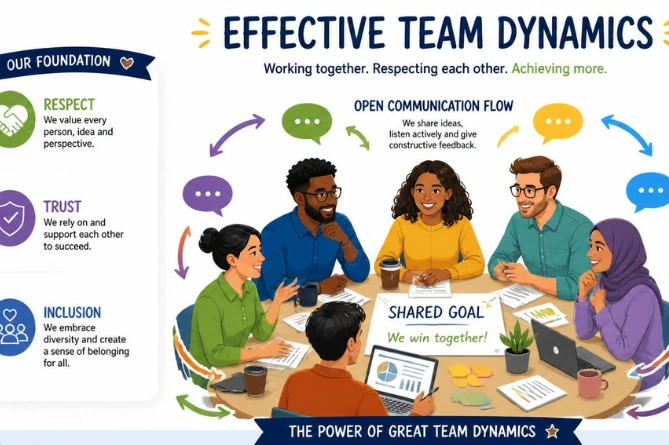
If you are asking what are examples of effective team dynamics, look at how people communicate, handle disagreement, share responsibility, and respond when something goes wrong. Strong teams do not depend on constant agreement or unusually talented individuals. Instead, they develop practical working habits that build trust, improve coordination, support better decisions, and make reliable execution easier.
These behaviors become especially important when teams face deadlines, unexpected problems, competing priorities, or difficult decisions. By observing how employees respond in these situations, managers can identify whether the team has healthy dynamics and where improvements may be needed.
Direct answer: Effective team dynamics include psychological safety, clear communication, defined roles, dependable follow-through, shared goals, constructive disagreement, inclusive participation, accountability, useful feedback, and adaptability. These behaviors help people exchange information, solve problems, make decisions, and complete interdependent work without creating unnecessary confusion or interpersonal friction.
| Effective dynamic | What it looks like at work | Warning sign when it is missing |
| Psychological safety | People raise concerns and admit mistakes. | Problems stay hidden. |
| Clear communication | Relevant information reaches the right people. | Surprises and misunderstandings are common. |
| Role clarity | People know responsibilities and decision owners. | Work is duplicated or ignored |
| Dependability | Commitments are completed, or risks are reported early. | Deadlines slip without warning. |
| Shared goals | Decisions support a common outcome. | Departments protect competing priorities. |
| Constructive disagreement | Ideas can be challenged respectfully. | Conflict is avoided or becomes personal. |
| Inclusive participation | Relevant voices influence decisions. | A few people dominate discussions. |
| Accountability | People own results without creating blame. | Mistakes trigger defensiveness. |
| Feedback | Guidance is specific and usable. | People learn about problems too late. |
| Adaptability | Plans change when evidence changes | Teams defend outdated decisions. |
Key Takeaways
- Strong teams make it safe to ask questions, challenge assumptions, and report problems.
- Clear ownership reduces duplicated effort and forgotten tasks.
- Healthy conflict improves decisions when people challenge ideas rather than attack colleagues.
- Dependability builds trust because coworkers know commitments will be handled.
- Inclusive participation brings more relevant information into decisions.
- Feedback and reflection help a group improve its working habits over time.
- Positive group behavior can be observed and strengthened; it is not simply a matter of personality fit.
What Team Dynamics Mean in Practice
Team dynamics are the recurring interactions, habits, expectations, and relationships that influence how a group works together. They affect who speaks, how information moves, how decisions get made, and what happens when priorities conflict. Two teams with similar skills and resources can produce different results because their working patterns are different.
Google’s Project Aristotle reached a similar conclusion after studying team effectiveness inside the company. Its researchers reported that how people worked together mattered more than simply who was on the team, identifying psychological safety, dependability, structure and clarity, meaning, and impact as five important dynamics.
What Are Examples of Effective Team Dynamics at Work?

The clearest answers to what are examples of effective team dynamics can be seen during normal work rather than special team-building events. Watch what happens when a deadline moves, someone makes a mistake, two specialists disagree, or a manager needs information that nobody wants to deliver.
These everyday situations reveal whether the group has productive working habits, clear communication, and mutual trust or relies on cooperation only when conditions are easy. Strong team dynamics become especially visible when employees must solve problems, manage pressure, share responsibility, and make decisions together. Observing these behaviors can help managers identify both strengths and areas where the team needs improvement.
1. People Feel Safe Speaking Up
Psychological safety means that a person can ask a basic question, admit uncertainty, report a mistake, or challenge an idea without fear of humiliation. For example, an analyst who notices a serious problem before launch tells the group immediately instead of hiding it to avoid criticism. Google identified psychological safety as the most important of the five dynamics found in its own team-effectiveness research.
Safety does not mean every suggestion gets approved or poor performance goes unaddressed. A healthy group can question an idea firmly while treating the person who offered it with respect. Leaders strengthen this behavior by inviting concerns, acknowledging their own uncertainty, and responding calmly when someone brings unwelcome information.
2. Communication Is Clear and Timely
Effective communication gives people the information they need before it becomes an emergency. Team members explain decisions, document changes, ask clarifying questions, and alert colleagues when a dependency may be delayed. The goal is not more messages; it is fewer surprises.
Meetings can also support communication when participation has a clear purpose. New teams may benefit from low-pressure conversation before tackling difficult work, and Thinkomics’ fun icebreaker questions for work and meetings provide prompts that encourage participation without forcing personal disclosure. Over time, the stronger signal is whether people feel comfortable sharing information that affects the work.
3. Roles and Decision Ownership Are Clear
A productive group knows who owns each task, who provides input, and who makes the final decision. Suppose a marketing campaign involves a writer, designer, analyst, media specialist, and project manager. Each person should know where their responsibility begins, what they owe others, and who resolves a disagreement that cannot be settled informally.
Role clarity should reduce confusion without creating rigid silos. Coworkers can still help one another, but assistance should not make ownership invisible. A meeting that ends with decisions but no named owners or deadlines usually creates work that must be rediscovered later.
4. Team Members Follow Through Reliably
Dependability develops when people complete commitments at the agreed standard and communicate early when that becomes impossible. A dependable employee does not wait until the deadline to reveal that another team member’s input is missing. Early notice gives the group time to change scope, reassign work, or adjust the schedule.
This behavior creates practical trust rather than trust based only on personal warmth. Colleagues learn that commitments matter, making planning easier across interdependent tasks. Google’s research listed dependability among the five factors associated with effective teams.
5. Everyone Understands the Shared Goal
Strong groups know what result they are trying to produce and use that outcome to settle smaller trade-offs. A product team, for example, may disagree on features while agreeing that the immediate goal is to reduce customer onboarding failures. The shared objective gives the disagreement a useful boundary.
Without common goals, departments may optimize their own metrics while weakening the final result. Marketing may chase lead volume, sales may favor easy-to-close prospects, and customer support may inherit customers who were never a good fit. Clear goals make it easier to ask whether a local decision helps or hurts the larger outcome.
6. Disagreement Improves the Decision
Constructive conflict happens when colleagues can challenge evidence, assumptions, priorities, or proposed solutions without turning the discussion into a contest between personalities. One person might question a forecast while another asks whether the sample is large enough to support it. The disagreement becomes useful because it exposes uncertainty before the decision is final.
Teams can strengthen this skill by separating the claim from the person making it. Thinkomics’ guide to developing stronger critical-thinking habits recommends defining the problem, checking evidence, considering alternatives, and discussing opposing views fairly. Those habits give workplace disagreement a structure that is more useful than arguing from confidence or seniority.
7. Participation Is Inclusive
Inclusive participation means the group actively considers relevant knowledge instead of assuming the loudest or most senior speaker has the best information. A manager may invite the engineer closest to a technical problem, ask a new employee what seems unclear, or collect written input before a meeting so quieter colleagues have another route to contribute. The objective is better information, not equal speaking time for its own sake.
Small interpersonal habits can affect whether people continue contributing. Repeated interruptions, stereotypes, dismissive jokes, or assumptions about someone’s background may reduce participation even when nobody formally excludes that person. Thinkomics’ overview of common microaggression examples can help managers recognize subtle behaviors that may undermine respectful collaboration.
8. Accountability Does Not Turn Into Blame
Healthy accountability means people take responsibility for commitments, decisions, and errors while the group remains focused on correction and learning. If a report goes out with incorrect figures, the owner should help correct it and explain what happened. The team should also examine whether unclear review steps or rushed handoffs made it easier to make the mistake.
Blame produces a different response because people start protecting themselves before protecting the work. Mistakes may be hidden, copied emails become defensive records, and meetings focus on proving who was responsible. Accountability works better when responsibility is clear, and lessons lead to changes in behavior or processes.
9. Feedback Is Specific and Useful
Effective teams do not save every performance conversation for an annual review. They give timely feedback about observable behavior, explain its effect, and clarify what should happen next. “Send the data source with future reports so reviewers can verify the figures” is more useful than “communicate better.”
Recognition also helps reinforce behaviors worth repeating. A leader can thank someone for flagging a risk early, documenting a complicated handoff, or helping another department meet a deadline. If your organization needs to formally assess collaboration, Thinkomics’ competency assessment guide explains why skills are easier to evaluate when written as observable behaviors rather than personality traits.
10. The Team Adapts and Reflects
Strong groups change their approach when evidence shows the existing plan is not working. Imagine a campaign team discovering two weeks before launch that its intended audience is responding poorly to early testing. Instead of defending earlier choices, members review the evidence, debate alternatives, assign revisions, and update the plan.
Reflection turns one adjustment into a learning process. After a project, the team can identify what helped, what slowed the work, and which working rule should change next time. CIPD’s evidence review highlights team reflection, information sharing, shared thinking, trust, and psychological safety among areas leaders should consider when building high-performing teams.
Strong Team Behavior vs. Poor Team Behavior
Good group interaction is easier to manage when leaders define it in observable terms. Words such as “collaborative,” “positive,” or “professional” can mean different things to different people. Concrete behaviors give managers and employees something they can discuss, practice, and measure.
| Situation | Strong behavior | Poor behavior |
| A mistake occurs. | Report it, correct it, and learn from it | Hide it or find someone to blame. |
| Two people disagree. | Test evidence and assumptions | Make the conflict personal. |
| A deadline is at risk. | Alert affected colleagues early. | Reveal the delay at the deadline. |
| A meeting ends. | Confirm decisions, owners, and dates. | Leave responsibilities unclear |
| A junior employee raises a concern. | Examine the concern on its merits. | Dismiss it because of seniority. |
| New evidence appears. | Reconsider the plan. | Defend the original decision automatically. |
These contrasts also help leaders spot poor dynamics before results collapse. Repeated silence, unclear responsibilities, unresolved tension, missed commitments, information hoarding, and meetings that end without decisions are useful warning signs. One difficult meeting does not prove a team is dysfunctional, but recurring patterns deserve attention.
How to Improve the Way a Team Works Together
Start by identifying one behavior that creates friction, rather than trying to “fix the culture” all at once. A group that repeatedly misses handoffs might clarify ownership and deadlines, while a group that avoids disagreement might introduce a structured review where someone is explicitly asked to challenge assumptions. Small operating rules are easier to observe and improve than broad value statements.
Leaders can use a simple improvement cycle:
- Define the behavior you want to change in observable terms.
- Ask team members where the current process creates friction.
- Agree on one working rule for the next project or two weeks.
- Observe whether the rule changes meetings, decisions, or delivery.
- Review the result and keep, revise, or remove the rule.
The leader’s own response matters throughout the cycle. If employees are invited to raise problems but are punished for doing so, the written rule will quickly lose credibility. Consistent behavior from managers is more persuasive than a workshop that is never reflected in daily decisions.
Why Effective Team Interaction Matters
Teams depend on one another to plan, exchange expertise, solve problems, and complete work that no single person owns from beginning to end. Weak working relationships add friction at each handoff because employees spend more time clarifying responsibilities, recovering missing information, avoiding conflict, or reopening decisions. Stronger patterns reduce that friction and make expertise easier to use.
Research does not suggest that every successful organization must copy one universal model. Google notes that its findings came from its own teams, while CIPD’s broader evidence review points to several related factors, including trust, cohesion, information sharing, shared thinking, and reflection. The practical lesson is to define the behaviors your team needs and examine whether everyday interactions support them.
Build Stronger Team Habits Through Everyday Work
The most useful place to improve group performance is within the work employees already do. Choose one recurring problem, define the better behavior you want to see, and test a new working rule during a real project. Review what has changed after a few weeks, and keep the practices that make communication, decision-making, accountability, and delivery clearer.
Strong teams are not groups that never disagree or make mistakes. They are groups that can surface problems without hiding them, debate options without damaging relationships, and adjust without losing sight of the shared goal. Make those behaviors part of ordinary meetings and projects, and better collaboration becomes something the team practices rather than something it merely values.
Conclusion
Understanding what examples of effective team dynamics are is important for any workplace that depends on people working together toward shared results. Strong team dynamics are built through everyday behaviors such as psychological safety, clear communication, dependable follow-through, defined responsibilities, constructive disagreement, inclusive participation, accountability, useful feedback, and adaptability. Effective teams do not need to agree on everything or avoid mistakes; instead, they create an environment where employees can raise concerns, challenge ideas respectfully, learn from problems, and adjust when circumstances change.
Frequently Asked Questions
Examples include psychological safety, open communication, dependable follow-through, clear roles, shared goals, constructive disagreement, inclusive participation, accountability, useful feedback, and adaptability. These behaviors make it easier for people to coordinate and solve problems together. You can identify them by watching what happens during deadlines, mistakes, decisions, and disagreements rather than judging whether coworkers get along.
Google’s Project Aristotle identified psychological safety, dependability, structure and clarity, meaning, and impact as five important factors in its effective teams. Psychological safety ranked first in the company’s findings. Google also emphasized that these results described patterns found within its own organization rather than a guaranteed formula for every workplace.
Teamwork refers to people cooperating to complete shared work, while team dynamics refers to the interaction patterns that influence how that cooperation occurs. A team can technically cooperate while still having weak communication, unclear ownership, or an unhealthy way of handling conflict. Healthy interaction patterns make effective teamwork easier to sustain under pressure.
Common warning signs include hidden mistakes, repeated missed deadlines, unclear roles, unresolved conflict, one person dominating discussions, and important information staying in private conversations. Another signal is a meeting culture in which decisions are repeatedly reopened because no one knows who has final authority. Look for recurring behavior across several situations rather than treating one bad day as proof of a deeper problem.
Trust can improve when leaders make expectations clear and then behave consistently enough for employees to predict what will happen. Start with practical commitments such as responding constructively to concerns, assigning clear owners, following through on decisions, and addressing disrespect when it occurs. Repeated evidence of dependable behavior usually matters more than asking employees to declare that they trust one another.