

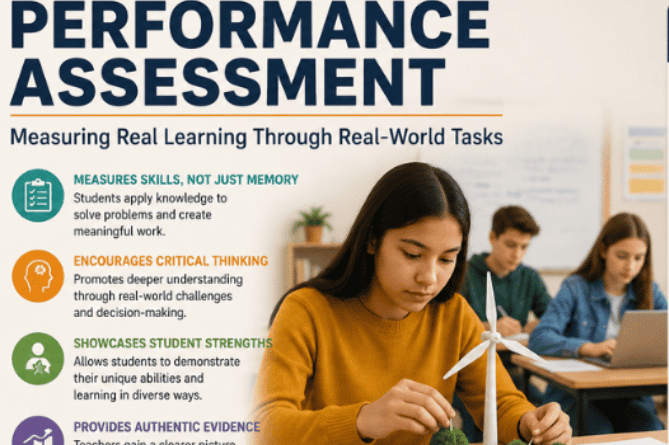
A performance assessment asks students to produce something instead of choosing a letter. They run the experiment, argue the case, build the model, or read a passage aloud, and a teacher scores that work against a written rubric. The payoff is evidence of skill rather than evidence of recall.
Teachers like the idea and dread the workload. That reaction is fair, so this guide stays practical. You get the task types, a rubric you can build in an afternoon, honest numbers on scoring time and drawbacks, plus the two states running this at scale. We cover this in more depth in Standardized Testing in U.S. Schools.
At a Glance
| Question | Short answer |
| What it is | A scored task where students make, do, or perform something |
| Common forms | Authentic tasks, portfolios, exhibitions, labs, oral defenses |
| Scored with | An analytic or holistic rubric is agreed upon before students start. |
| Typical length | One class period up to a multi-week project |
| Main strength | Shows reasoning and process, not only the final answer |
| Main cost | Teacher hours, plus the risk of two scorers disagreeing |
| Run at scale by | New Hampshire PACE, the New York Performance Standards Consortium |
Key Takeaways
- The task has to require the skill you claim to be measuring, or the score means nothing.
- Analytic rubrics give students useful feedback. Holistic rubrics score faster.
- Four levels beat five, because a middle box invites scorers to hide there.
- Agreement between teachers is built by calibration, not by good intentions.
- Budget the scoring time before you write the task, not after.
- Two US states have swapped part of their testing program for scored classroom tasks.
What Counts as a Performance Assessment?

The label covers any task where a student generates the response and a scorer judges it against stated criteria. That definition rules out multiple-choice and includes a surprising amount of ordinary classroom work.
Four forms show up most often in American schools:
- Authentic tasks. A problem framed the way it appears outside school. Students cost out a school garden, write a letter to the city council, or diagnose a fault in a circuit.
- Portfolios. Work curated across a term, with the student explaining why each piece was chosen and what improved.
- Exhibitions. Students present and defend in front of teachers, peers, or outside panelists who ask follow-up questions.
- Performance events. A single sitting where students carry out a lab, a translation, a musical piece, or a timed design challenge.
Plenty of material you already teach converts cleanly. Open-ended problems of the kind used in math enrichment ideas for deeper learning become scorable tasks the moment you attach criteria to the reasoning students show.
Where Standardized Tests Stop, and Tasks Begin?
Selected-response tests are cheap, fast, and genuinely good at one job: sampling a lot of content quickly. What they struggle with is depth of thinking, and there is measurement evidence on exactly how far they fall short.
Performance Assessment: Kun Yuan and Vi-Nhuan Le rated state test items by depth of knowledge for a 2012 RAND working paper on cognitively demanding test items. They found that 3 to 10 percent of US elementary and secondary students were assessed on deeper learning through at least one state test, and 0 percent in mathematics. That figure describes the pre-reform baseline, and it explains why districts started building tasks of their own.
| Feature | Multiple-choice test | Scored task |
| What the student does | Recognizes a correct option | Produces a response from scratch |
| Scoring cost | Near zero, the machine scored | Teacher time, every single paper |
| Content sampled | Wide, many topics per hour | Narrow, one problem in-depth |
| Score consistency | Very high by design | Depends on the rubric and training |
| Feedback value | A percentage | Named strengths and next steps |
| What it can miss | Reasoning, planning, revision | Breadth of curriculum coverage |
Neither column wins outright. Use each for what it does well. Please don’t ask a bubble sheet to certify the reasoning habits described in these daily ways to enhance critical thinking.
Building a Rubric That Holds Up

Most weak tasks are really weak rubrics. A criterion like “quality of work““””” tells a student nothing and permits two teachers to disagree. Start by choosing a rubric type. Analytic rubrics split the work into separate criteria and score each one. Holistic rubrics give a single judgment against a whole-task description.
| Choose | When | Trade-off |
| Analytic | Students will revise, or you need diagnostic detail. | Slower to score, richer feedback |
| Holistic | High volume, or the criteria interact heavily | Fast, but the score explains little. |
Then build it in four moves:
- Write the three or four criteria that carry the standard. Cap it there. Nine criteria produce a checklist, not a judgment. Cites two sources and explains how each supports the claim is scorable. Uses sources well” is not.
- Use four levels. An odd number gives scorers a comfortable middle box, and they will use it.
- Score one real student sample against the draft, then fix whatever you had to argue with yourself about.
Give students the rubric before they start. Skills built through repeated practice, such as the ones behind proven ways to improve reading fluency, improve much faster when learners can see the target they are aiming at.
Getting Two Teachers to Agree
Inter-rater reliability is the share of the time two independent scorers land on the same result. It is the single technical weakness of this approach, and it is fixable. Calibration is the routine that fixes it. Pick four anchor papers spanning the full range, score them independently as a department, then meet and argue out every disagreement against the rubric language. Wording that caused a split gets rewritten on the spot.
After calibration, double-score a sample. Around 10 percent of papers is a workable share for a classroom team, and it tells you whether the training held. Where scores drift apart by more than one level, a third reader settles it, and the rubric gets another edit. Skip this and you have not measured a student. Youhave identified which teacher picked up the paper.
What Scoring Really Costs?
I couldn’t find a published number, so I’m sharing a working planning estimate rather than a research finding. Time it yourself on the first round and adjust.
| Task type | Planning estimate per student | Class of 28 |
| One-period task, analytic rubric | 5 to 8 minutes | 2.5 to 4 hours |
| One-period task, holistic rubric | 2 to 3 minutes | 1 to 1.5 hours |
| Portfolio review | 15 to 25 minutes | 7 to 12 hours |
| Exhibition with panel | 10 to 15 minutes | 5 to 7 hours |
Put a dollar figure on it before you commit. At a $35 hourly stipend, one portfolio round across four sections runs past $1,000 in scoring alone, and that money has to come from somewhere. Those hours are the real constraint. Pretending otherwise is how these programs collapse in year two. Three or four scored tasks a year, spaced across the calendar, is a schedule teachers can keep. Twelve is not.
How Do New Hampshire and New York Run It?
New Hampshire built the most thoroughly studied state model. Its PACE program, short for Performance Assessment of Competency Education, launched in 2015. Participating districts test once per grade span instead of annually, and common or locally designed tasks carry the rest of the load.
The obvious worry was coverage. If a district drops most annual testing, do teachers quietly narrow the curriculum? A 2023 study in Applied Measurement in Education, Keeping Up the PACE, examined grade 8 outcomes after five years using propensity score matching and hierarchical linear modeling. PACE students scored about the same as matched non-PACE students in both mathematics and English language arts, with no differential effect for students on an individualized education program.
New York took a different route. The Performance Standards Consortium is a group of New York City public high schools with a state waiver. Its students graduate on performance-based tasks in place of most Regents exams, keeping the English exam. They defend written analytical work in front of a panel, and external reviewers audit the scoring.
Both systems answer a question families ask constantly: what does a school’s published number stand for? If you are weighing schools, it pays to understand how school ratings are calculated before treating any single score as the verdict.
Drawbacks and Where Performance Tasks Go Wrong
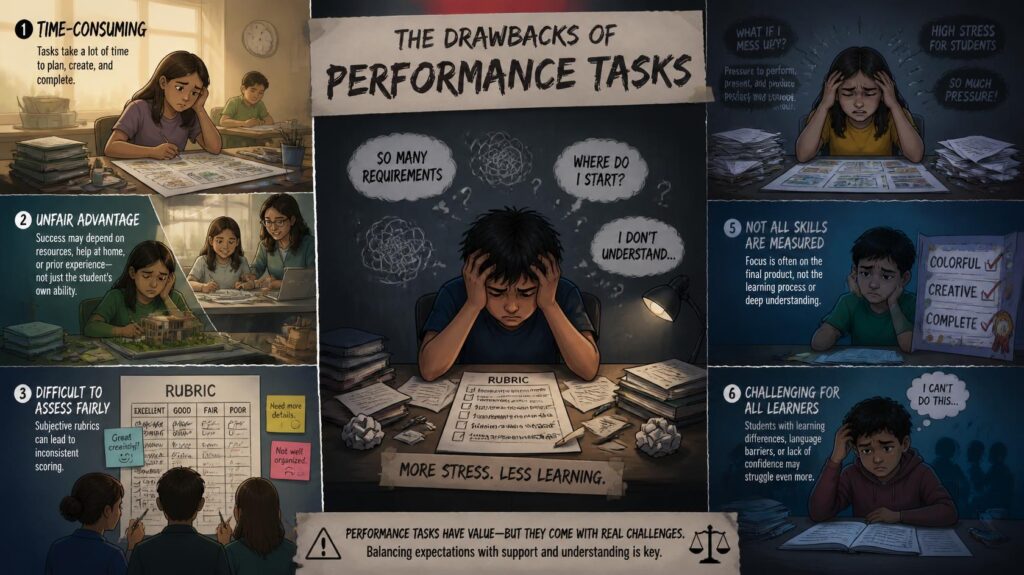
The drawbacks are real. Scoring takes hours, agreement between teachers is fragile, and a single task covers far less curriculum than an hour of multiple-choice. Five failure patterns account for most of the damage.
- This task doesn’t require that skill. A poster about photosynthesis measures poster-making. Ask for a prediction and a defense instead.
- Effort gets scored. Neatness, length, and visible enthusiasm sneak into rubrics and inflate grades. Keep criteria tied to evidence.
- Group work hides individuals. Score a product every student contributes to individually, or add an oral check. The habits behind good collaboration deserve their own attention through social-emotional learning activities.
- Every level says “somewhat. If the difference between level two and level three is an adverb, scorers cannot apply it.
- Nobody calibrates. The rubric looks fine, and the scores still wander.
Your Next Step?
Performance Assessment: Pick one unit you already teach and one standard inside it. Write a task that forces students to show the reasoning that standard describes, draft four criteria, and score a single class. Compare a few papers with a colleague before you attach a grade to anything. One task done properly teaches you more than a district rollout.
Frequently Asked Questions
It is a task where students create a response and a teacher scores it against written criteria. Lab reports, debates, portfolio defenses, and recorded readings all qualify. The student produces the evidence rather than selecting it.
Multiple-choice tests sample wide content quickly and score themselves. A scored task samples one problem deeply, shows how students got there, and costs teacher time. They answer different questions about the same learner.
They can be, with a specific rubric, calibrated scorers, and double-scoring on a sample. Without those three, agreement between teachers drops fast and the grade reflects the scorer as much as the student.
Three or four is realistic for most teachers, spaced so the scoring never lands in the same week as report cards. Quality per task matters far more than the count.
Yes. New Hampshire’s PACE program uses classroom tasks alongside reduced state testing, and New York’s Performance Standards Consortium schools graduate students on performance tasks under a state waiver.
Not on current evidence. Wide content coverage and cross-district comparability are still easier to get from a common test, so most systems that adopt scored tasks run both.