


Every vendor page selling education IT support to schools promises the same three things: fast response, strong security, and happy teachers. Almost none say how many technicians a district of 4,000 students needs, or what a help desk seat costs. This guide answers both, using public figures, state, and federal sources. Read it before your next renewal.
Education IT support is the team and service layer that keeps a district’s devices, networks, accounts, and student data working. Districts run it three ways: an in-house team on payroll, a managed provider under contract, or a co-managed blend of both. Cost, response speed, and security depth are what separate the models.
| Article overview | Details |
| Who is this for? | US K-12 district leaders and school boards |
| Three delivery models | In-house team, fully managed provider, co-managed blend |
| Benchmark staffing ratio | One support staff member per 670 devices (Connecticut, 2024) |
| Median technician wage | $60,340 a year for user support specialists (BLS, May 2024) |
| Main funding routes | E-Rate Category Two, state grants, the general fund |
| Peak workload | August and September, when devices and accounts go out at once |
Key Takeaways
- Staffing is the whole argument. Count devices first, then pick a model.
- A district of 4,000 devices needs roughly six support staff at the benchmark ratio.
- Co-managed suits most mid-size districts, with one internal lead owning the roadmap.
- Cybersecurity duties stay with the district no matter who answers the phone.
- E-Rate pays for infrastructure, not for people. Budget salaries separately.
What Does Education IT Support Actually Cover?

That phrase hides several separate jobs. One district technology team runs a small internet provider, a repair shop, an identity system, and a compliance program at once.
- Help desk and repair. Broken screens, forgotten passwords, projectors that will not wake up.
- Device lifecycle. Buying, imaging, tagging, insuring, and retiring student devices.
- Network and wireless. Access points in every classroom, plus bandwidth for testing weeks.
- Identity and accounts. Opening and closing thousands of student accounts every fall.
- Core systems. Student information system, learning platform, and gradebooks.
- Security and compliance. Backups, patching, filtering under CIPA, and privacy under FERPA.
Teachers feel the gap first. Even simple classroom methods that stall when devices fail get abandoned after two bad mornings. Online programs raise the stakes again, because a family in a virtual school program run from home has no hallway to walk down when the login breaks.
How Many Technicians Does a District Need?
No federal standard exists, so districts guess. State data is the closest benchmark, and one state publishes it. The Connecticut Commission for Educational Technology surveyed 62 districts serving 200,380 students for its November 2024 report on technology staffing. It found an average of one support staff member for every 670 devices and a statewide figure of one per 1,008 devices. Spread was wide: one per 300 devices at the strongest- staffed district, one per 2,667 at the leanest.
Use devices, not students, as the unit. A district of 4,000 students on a one-to-one program usually manages 4,500 endpoints once you add teacher laptops and panels. At the 670 benchmark, it needs about seven support staff. At the statewide figure, it limps along with four.
Now price it. The Bureau of Labor Statistics put the median annual wage at $60,340 in May 2024 and at $73,340 for network support specialists. Add benefits and payroll taxes, and one technician costs near $78,000. Seven run past $540,000 a year before you buy a switch.
Ticket load: What one technician can handle
Education IT Support Ratios describe the steady state. Ticket volume describes the day. School technology work is seasonal; corporate work is not. August and September bring device handouts, account creation, and every returning teacher discovering that the cart will not charge. Size a team for February, and it drowns in the fall surge, so districts hire seasonal help or write surge coverage into the contract.
Plan on 8 to 12 resolved tickets per technician per day, once travel between buildings is counted. Push past that and response time slips, teachers stop reporting problems, and your data stops reflecting reality. Watch tickets opened per 100 devices, time to first response, and the share reopened within a week.
Workload follows what teachers are asked to do. A rollout of digital choice board activities across a grade level lands as a hundred small requests in the time it takes a week. So does a move between synchronous and asynchronous learning formats, because each format leans on different tools. Ask the instructional team for its calendar before you set staffing.
In-House, Managed, or Co-Managed

Rivals blur these models together. Compare them properly, then read the pros and cons under the table.
| Model | Who does the work? | Cost shape | Best fit | Main risk |
| In-house team | District employees | Salaries and benefits, fixed | Districts above 5,000 students with stable funding | One resignation removes a whole skill set. |
| Fully managed | An outside provider under contract | Monthly fee per device or per user | Charters and districts under 2,000 students | Slower on district-specific systems and culture |
| Co-managed | A district lead plus a provider bench | Base fee plus internal salaries | Districts of 2,000 to 10,000 students | Work falls between the two unless duties are written down. |
In-house strengths: people who know your buildings, principals, and testing calendar. They walk to the classroom. They also cost the most per head and rarely cover a Saturday outage.
Managed strengths: a bench instead of a person, coverage outside school hours, and security tooling a small district could never buy alone. The trade is distance. A remote agent does not know that the third-grade hallway has one weak access point.
Co-managed strengths: you keep a technology director and a field technician, then buy monitoring and specialist skills. The trade is management overhead, because someone has to own the split.
The verdict for most districts
For districts between 2,000 and 10,000 students, we recommend the co-managed model. It keeps the classroom relationship inside the district while renting what is hardest to hire: 24-hour coverage and security expertise.
Go fully in-house only if you can fund at least four technicians plus a director and can replace any one of them within 90 days. Go fully managed if you are under 2,000 students, or if your technology director post has sat open for a year. Cheaper is not the same as adequate. The cheapest model is whichever one matches your device count.
Cybersecurity Duties: The District Still Owns
A contract moves work. It does not move accountability. Your district still owns every duty that belongs to whoever holds the data.
- Approving who may see student records and reviewing that list yearly.
- Deciding what gets backed up, how often, and where the copy lives.
- Naming an incident commander and a board notification path in advance.
- Reviewing every ed tech vendor’s data agreement, not only this contract.
- Running the tabletop exercise, with principals in the room.
Getting this wrong is measured in school days. A 2022 report from the U.S. Government Accountability Office found that districts hit by a cyberattack lost three days to three weeks of learning and needed two to nine months to recover, and the contract makes that a vendor problem.
How Schools Pay For It

Funding is where most plans break: the money that buys equipment cannot buy people.
| Source | What it pays for | What it will not pay for |
| E-Rate Category One | Broadband and internal connections to the building | Staff, devices, software |
| E-Rate Category Two | Switches, access points, and firewalls inside the building | Salaries, help desk contracts |
| State technology grants | Often devices or infrastructure | Usually recurring salaries |
| General fund | Salaries, help desk contracts, repairs | Nothing, which is why it is tight. |
The federal E-Rate Category Two budget gives schools $201.57 per student across the FY2026 to FY2030 cycle, with a floor of $30,175. For a 4,000-student district, that is roughly $806,000 over five years, all of it for equipment. Security funding is thinner. According to the Federal Communications Commission, its Schools and Libraries Cybersecurity Pilot Program offers up to $200 million to selected participants over a three-year term. That is a pilot. It is not a line every district can count on.
Federal ESSER relief money has now run out. Many districts bought devices in 2021 that came due for replacement with no fund behind them. Boards weigh that bill against everything else shaping how school ratings are calculated, which is why technology renewal loses budget votes.
Questions to Ask Before You Sign
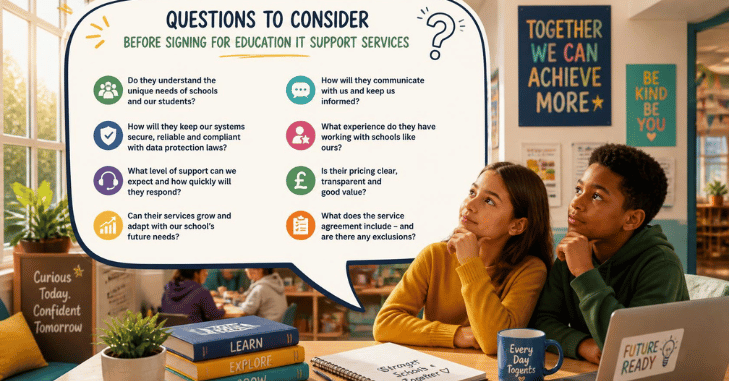
- What is your guaranteed first-response time during August, in writing?
- How many named engineers will know our student information system?
- Who owns our administrator credentials, and how do we get them back?
- Show us a ticket report from a district our size, with resolution times.
- Which security tasks stay with us, listed line by line?
Get that last answer in writing. A provider that cannot draw the line between its duties and yours will not draw it during an incident either.
Your Next Step
Pull two numbers this week: your endpoint count and your support headcount. Divide one by the other. Is the result worse than one per 1,000 devices? Then no contract wording will fix it. Bring that number to your board before you bring them a quote.
Frequently Asked Questions
It covers the help desk, device lifecycle, the network, accounts, core systems such as the student information system, and privacy compliance. Districts deliver it with employees, a provider, or a mix.
Plan for 8 to 12 resolved tickets a day, and expect double that in the first three weeks of school. A team running above 15 a day for months is seeing suppressed demand, not efficiency.
Under 2,000 students, usually yes, because you cannot fill a technician’s day. Above 5,000 students, the salary math turns, and a hybrid arrangement beats either extreme.
No. E-Rate funds connectivity and network equipment. Basic maintenance of eligible gear can qualify, but help desk services and salaries come out of the general fund.
Ask for a written response-time commitment covering the back-to-school period, plus a sample ticket report from a similar district. Vague service levels cause most year-two regret.