

An emotion chart helps you move from a broad reaction, such as “I feel bad,” to a more precise feeling, such as disappointed, lonely, overwhelmed, or uneasy. That added detail can make it easier to understand what triggered your response, communicate your needs, and choose a sensible next step.
You don’t need psychology training to use one. Start with the closest basic feeling, explore the related words, and select the label that best matches your experience.
| Key point | Practical answer |
| What it is | A visual list or wheel that groups related feelings |
| Main purpose | To help you identify and describe emotions |
| Common formats | Wheels, color-coded grids, lists, and intensity scales |
| Useful for | Reflection, journaling, classroom discussions, and communication |
| Best way to use it | Name the feeling, rate its intensity, identify the trigger, and choose a response. |
| Important limitation | It supports self-awareness but doesn’t diagnose mental health conditions. |
Direct answer: A feelings chart is a visual tool for identifying and describing emotional states. You begin with a general category, such as anger, sadness, fear, or joy, then narrow it to a more specific word. This process gives you clearer language for reflection, communication, and emotional regulation.
What Is an Emotion Chart?
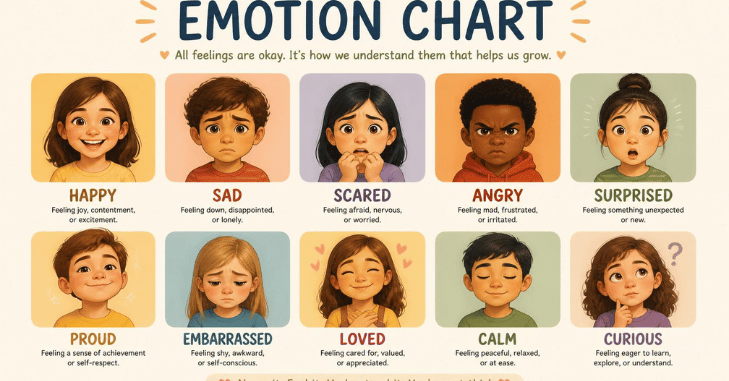
An emotion chart organizes feeling words into groups so you can identify what is happening inside you. Some versions use a simple grid. Others arrange feelings in circles, with broad categories near the center and more detailed terms around the outside.
The chart acts as a vocabulary prompt. Instead of forcing you to remember the right word while you’re upset, it presents several possibilities that you can compare. Emotions involve subjective experience, bodily responses, thoughts, and observable behavior. That complexity explains why one-word descriptions often feel incomplete.
For example, “angry” might be accurate but too broad. A closer look may reveal what you feel.
- Ignored
- Betrayed
- Pressured
- Embarrassed
- Frustrated
- Powerless
Setting a boundary. Each setting a boundary. Each label points toward a different problem. Feeling ignored may call for a conversation. Feeling pressured may call for a boundary to be set. Feeling embarrassed may call for reassurance or perspective.
Readers interested in broader learning and self-development topics can also explore Thinkomics’ education resources.
Why Does Naming a Feeling Matter?
Precise language helps separate the emotion from the action you might take. You can feel furious without shouting. You can feel anxious without avoiding the task. You can feel disappointed without deciding that the entire situation is hopeless.
This pause creates room for choice.
A useful label can also improve communication. Compare these two statements:
- “You’re making me feel terrible.”
- “I feel excluded because the decision was made without me.”
The second sentence gives the listener something specific to understand and address. It describes the feeling, connects it to an event, and avoids guessing another person’s motives.
Emotion researchers don’t all use the same classification system. Paul Ekman’s work identified six widely recognized basic emotions: anger, surprise, disgust, enjoyment, fear, and sadness. Robert Plutchik’s model uses eight core categories arranged as opposing pairs and shows different levels of intensity.
These models aren’t competing answer keys. They’re frameworks that help people organize a complex part of human experience.
Common Types of Feelings Charts

Feelings Wheel
A feelings wheel places broad categories near the center. More specific words appear in the outer sections.
You might begin with sadness, then move toward loneliness, grief, disappointment, or helplessness. This format works well when you know the general direction of the feeling but can’t find an exact label.
Plutchik’s well-known wheel uses eight primary emotions and represents changes in intensity through its layered design. It also illustrates how nearby emotions may combine.
Grid Or Table
A grid presents emotions in rows, columns, or color-coded groups. It may organize words by:
- Pleasant or unpleasant experience
- High or low energy
- Mild or strong intensity
- Basic and complex feelings
This format can be easier for younger students or anyone who finds a circular diagram crowded.
Intensity Scale
An intensity chart groups related words from mild to strong. For anger, a scale might move from annoyed to frustrated, angry, furious, and enraged.
—matters Step away from intensity. Matters because your response should fit the strength of the feeling. Mild irritation may need a short break. Intense anger may require you to step away from the situation until your body settles.
Body sensation Chart
Some tools connect emotional words with physical clues. Anxiety may involve tense shoulders, fast breathing, stomach discomfort, or restlessness. Sadness may involve low energy, heaviness, or tearfulness.
Physical sensations don’t prove a particular emotion. They provide additional clues, especially when emotional words are hard to access.
How to Use an Emotion Chart in Five Steps
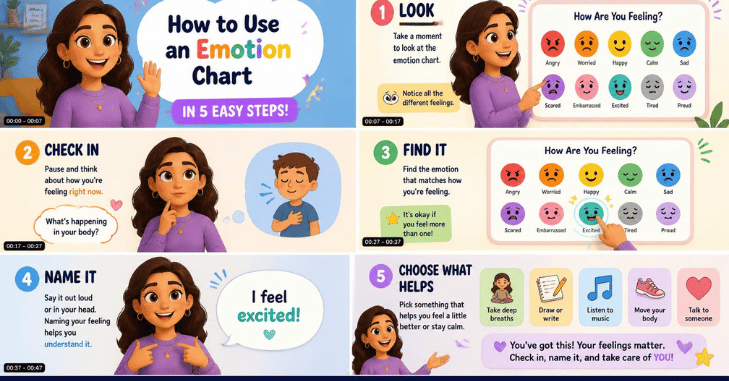
1. Pause Before Choosing a Word
Take one slow breath and notice what is happening. Avoid judging the reaction as good, bad, weak, or unreasonable.
Your first task is observation, not correction.
2. Choose The Closest Broad Category
Select the category that seems most accurate. Common starting points include:
- Anger
- Fear
- Sadness
- Joy
- Surprise
- Disgust
You may notice more than one. Mixed emotions are normal, so you don’t need to force the experience into a single category.
3. Narrow It To A Specific Feeling
Review the related terms and choose one or two that fit.
Suppose you’re nervous about presenting a class project. “Fear” may be technically correct, but exposed, self-conscious, uncertain, or unprepared may describe the experience better.
Thinkomics’ student guides can provide a natural next step when the feeling relates to academic pressure or study habits.
4. Rate Its Intensity
Use a scale from 1 to 10.
A rating gives you a quick way to track change. You might begin at 8, take a short walk, review your notes, and notice the feeling has fallen to 5.
The number isn’t a clinical score. It is a personal reference point.
5. Connect The Feeling To A Need
Ask:
- What happened just before this feeling appeared?
- What am I worried might happen?
- What do I need right now?
- Is there a helpful action I can take?
- Do I need support from another person?
Naming the need turns awareness into a practical response.
A Worked Example
Imagine that a student receives a lower grade than expected.
The first reaction might be, “I’m angry.” After checking an emotion chart, the student identifies three more accurate words: disappointed, embarrassed, and worried.
Those labels reveal separate concerns:
| Feeling | Possible meaning | Constructive response |
| Disappointed | The result didn’t match the effort | Review what went wrong |
| Embarrassed | The student fears others’ judgment | Challenge assumptions about what others think |
| Worried | The grade may affect future results | Ask the teacher how to improve |
| Frustrated | The feedback feels unclear | Request a clearer explanation |
This method prevents a single broad reaction from controlling the next decision. It also produces several manageable actions.
Students learning remotely may find related support in Thinkomics’ online learning section.
Using the Tool With Children and Students

Keep the process simple for younger users. Begin with a small number of familiar categories and add detailed words over time.
Useful prompts include:
- Which face looks closest to yours?
- Does the feeling have high or low energy?
- Where do you notice it in your body?
- Did the feeling become stronger or weaker?
- What would help you feel safe or understood?
Avoid telling a child what they “must” be feeling. Offer possibilities and let them choose. A child may also need time before answering.
Teachers can use a private check-in sheet at the start of class. Students may circle a word and rate its strength without having to explain it publicly. This supports reflection while respecting privacy.
Mistakes That Make the Tool Less Useful
Treating The Label As a Diagnosis
A chart describes a current experience. It cannot determine whether someone has anxiety, depression, trauma, or another condition.
Searching For One Perfect Word
Human reactions often include several feelings. You may feel proud and nervous before a performance or relieved and sad after finishing a major project.
Skipping The Trigger
A label becomes more useful when connected to context. “I feel resentful” gives information. “I feel resentful because I agreed to more work than I could handle” gives direction.
Using It To Argue With Someone
The tool should clarify your own experience, not prove that another person is wrong. Try to describe what you felt, what happened, and what you need next.
Assuming Unpleasant Feelings Are Harmful
Fear, anger, sadness, and disgust can carry useful information. The goal isn’t to remove every uncomfortable response. It is to understand the signal and respond without causing avoidable harm.
When a chart isn’t enough?

A visual tool can support daily reflection, but it has limits. Consider speaking with a qualified mental health professional when emotions remain overwhelming, interfere with school or work, damage relationships, or lead to unsafe behavior.
Seek urgent local support if you or someone else may be in immediate danger. Using a chart alongside professional care may still help. It can give you examples to discuss, show patterns over time, and make appointments more focused.
Conclusion
An emotion chart is a simple yet powerful tool for building emotional awareness and improving communication. By helping you identify and name your feelings more accurately, it becomes easier to understand your reactions, respond thoughtfully, and express your needs with confidence.
Whether you’re a student, teacher, parent, or professional, regularly using an emotion chart can strengthen emotional intelligence, reduce misunderstandings, and support healthier relationships. Remember, the goal isn’t to avoid difficult emotions but to recognize them, learn from them, and choose constructive ways to respond.
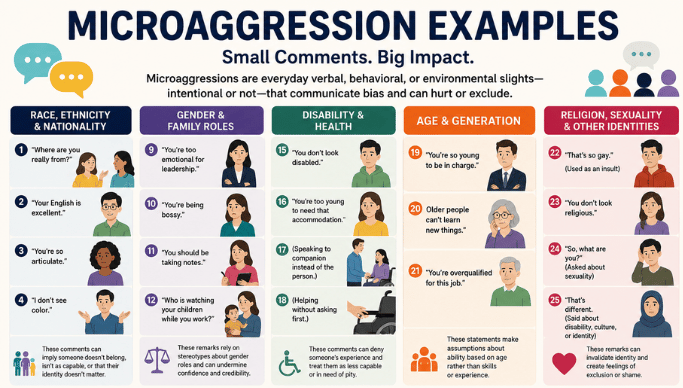
Apart from that, if you want to know about the article Microaggression Examples, then visit our Education category:
Frequently Asked Questions
It helps people recognize, name, and communicate feelings. It can also support journaling, classroom check-ins, conflict discussions, and conversations with counselors or therapists.
A wheel is a psychological framework, not a complete map of every human experience. Different researchers organize emotions in different ways. Its practical value comes from providing structured vocabulary, not from proving that every feeling fits one fixed model.
The terms overlap in everyday speech. Some psychological explanations describe emotions as broader reactions involving physical, mental, and behavioral components, while feelings refer to the conscious experience or interpretation of those reactions.
Use it when you struggle to explain a reaction, notice a strong mood shift, or want to reflect on a repeated pattern. A brief daily check-in may also help build emotional vocabulary.
Yes. Choose a simple version with clear words, faces, or colors. Adults should guide the process without insisting on a particular answer.