

Authentic Assessment asks students to do the real job and then judges that work the way someone outside school would. A quiz checks whether a student can pick the right answer from four. A performance task checks whether they can produce one when the problem is messy, and nobody has numbered the steps. For the full picture, read Competency Assessment.
Page one keeps leaving out the practical half. So below you get nine examples sorted by grade band, a six-step build, and a rubric with real point values. Time costs and disadvantages come after that.
At A Glance
| What teachers ask | Short answer |
| What is it | A task that mirrors real work, scored against criteria students see first. |
| Common formats | Performance, product, exhibition, portfolio, simulation, defense |
| Usual role | Summative, at the close of a unit |
| Scoring tool | An analytic rubric, four to five criteria, shared in advance |
| Class time | Two to five periods for most units |
| Grading time | Roughly 4 to 8 minutes per student |
| Biggest risk | A task that looks real but scores polish instead of skill. |
| Poor fit for | Spelling patterns, math facts, vocabulary recall |
Key Takeaways
- Write the rubric before the assignment sheet. If you cannot describe top-level work, the task is not ready.
- Give the work an audience. That one move separates a real task from a decorated worksheet.
- Budget two to five class periods, plus about an hour of design the first time you run it.
- Calibrate scoring with a colleague on three samples before you grade the rest.
- Keep short tests for the things short tests measure well.
What Counts as Authentic Assessment?
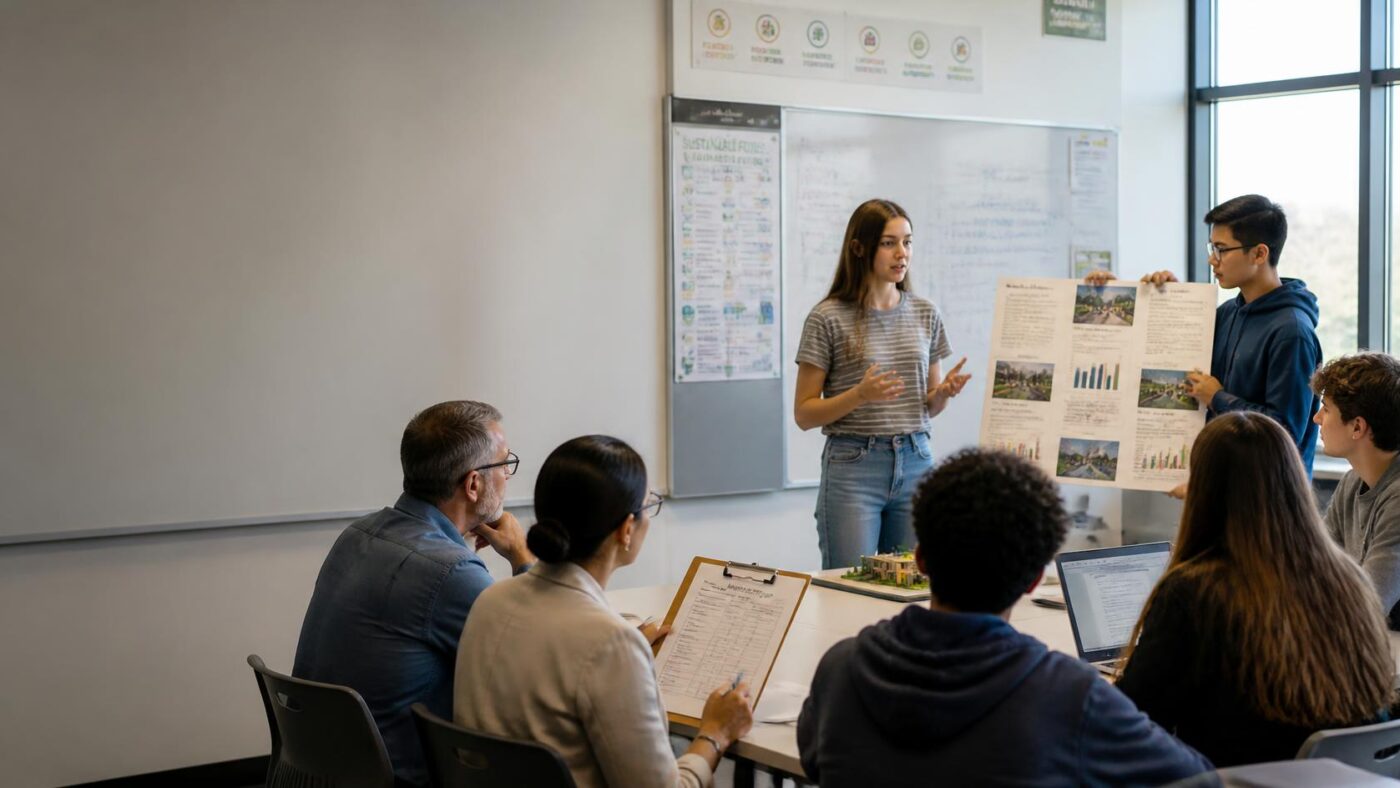
Authentic Assessment: Grant Wiggins framed the idea in the late 1980s with a plain test. The challenge students face should look like the real challenge, not a paper stand-in for it. So a science unit ends with a water-quality report written for the county board, not forty items about pH.
Three things have to be true at once. The work has to resemble something adults do for pay. The student has to make judgment calls rather than follow a recipe. And the criteria have to be public before anyone starts.
A Four-Question Test For Any Task
- Would a professional recognize this job? Engineers build and load-test. Historians argue from sources. Dietitians plan meals against a budget. If no adult does anything close, the task is school-shaped.
- Does the student decide something? Choosing a method, a trade-off, or an audience counts. Choosing a poster border does not.
- Is there a reader beyond the grade book? Younger students, a club, a local business, the school board. Anyone real.
- Could a student score well on presentation alone? If yes, the criteria are measuring craft supplies.
How It Differs From A Traditional Test?
| Feature | Traditional test | Real-world task |
| What it shows | Recall and recognition | Application under messy conditions |
| Conditions | Timed, silent, closed book | Resources, drafts, sometimes a team |
| Correct answers | One | Several defensible ones |
| Scoring | Answer key | Analytic rubric |
| What students get back | A score | Specific next steps they can use |
| Strongest use | Checking coverage quickly | Judging whether a skill transfers |
For authentic Assessment, the trade tends to pay. Researchers at the UChicago Consortium on School Research read more than 2,000 classroom assignments across 19 Chicago elementary schools. Nearly 5,000 students in grades 3, 6 and 8 sat behind those assignments.
Their 2001 report found that students given work demanding authentic intellectual effort posted reading and math gains about 20 percent above the national average on the Iowa Tests. Students handed the weakest assignments fell 25 percent below average in reading.
Where Formative Checks Fit
These tasks are almost always summative. That does not make the quick stuff optional. You still need formative checks that steer a lesson while it is running. A student who cannot defend a claim on Tuesday will not produce a defensible report on Friday.
The split is timing and purpose. Formative evidence changes what you do this week. Performance tasks show what the whole unit built.
9 Examples, From Second Grade To Senior Year

Elementary, grades 2 to 5
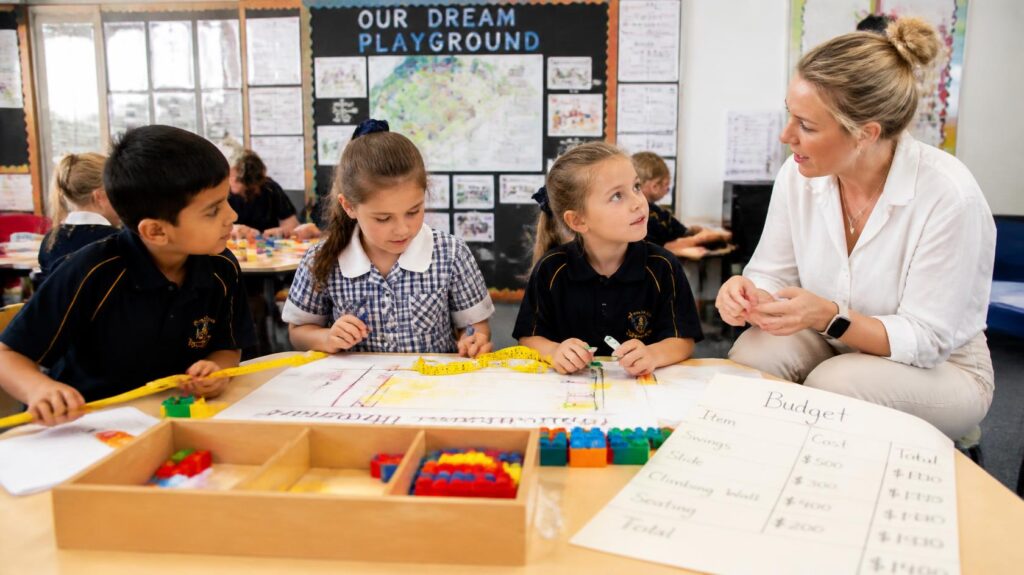
- Playground redesign. Students measure the yard in feet, price equipment from a real catalog, and pitch a plan under $2,000 to the principal.
- Weather desk. One week of temperature and rainfall readings becomes a two-minute forecast, recorded on a tablet and played for a first-grade class.
- Class cookbook. Students halve and double recipes, cook one at a family night, and write the steps clearly enough for a stranger to follow. Pairs neatly with deeper math enrichment activities already running in your room.
Middle School, Grades 6 To 8
- Neighborhood museum. Small teams research a local site from primary sources, write exhibit labels under 120 words, and run a gallery walk for fifth graders.
- Load-tested bridge. Spaghetti or balsa, weighted in front of the class, submitted with a written failure analysis explaining where the design gave way.
- Consumer report. Three brands of paper towel, one controlled test, published method and verdict. Students who fudge the method get caught by classmates, which is the point.
High school
- Mock trial. Students argue a real case, scored on evidence handling and cross-examination rather than theatrics.
- Public health campaign. County health data, a named target audience, and a five-minute pitch to the school board.
- Business plan. A costed launch, a break-even point, and unscripted questions from a local shop owner.
Build One in Six Steps

- Name the standard first: one sentence, one skill. “Students will use ratio reasoning to solve a real pricing problem” works. “Students will explore ratios” does not.
- Find the adult version. Ask who does this outside school and what they hand over at the end. That artifact becomes your product.
- Fix the standard, open the format. Build a student choice board on one shared rubric so a learner can pick video, brief, or model while the skill being judged stays identical.
- Write the rubric before the assignment sheet. Draft the top level first. If you cannot describe it in concrete terms, the task needs another pass.
- Teach up to it. Model the reasoning, run guided practice, then release. The classroom methods that build toward independent work carry more weight here than in a unit ending with a quiz.
- Give it an audience. Zhan, Boud, and Du reviewed 37 studies of task design for the journal Higher Education in 2025. They found only 3 of them examined social authenticity, meaning students answering to someone real. It is the cheapest upgrade on this list, and almost everyone skips it.
A Rubric You Can Copy Tomorrow
Four criteria, 30 points, one page. Hand it out on day one.
| Criterion | What top-level work looks like | Points |
| Accuracy | Every fact, figure, and calculation checks out | 8 |
| Evidence | Three or more sources, cited, each doing real work in the argument | 8 |
| Reasoning | Explains why this solution fits and names one trade-off it accepts | 8 |
| Communication | A stranger in the audience follows it without asking questions | 6 |
Notice what is missing. No points for glitter, fonts, or slide transitions, unless visual design is the standard you are teaching.
What It Costs You in Time?
Authentic Assessment costs more than a quiz. Here are the numbers from a typical middle school unit, so you can decide before you commit.
- Design: 60 to 90 minutes the first time. About 20 minutes the second time.
- Class time: two to five periods, including one workshop period for drafts and feedback.
- Grading: 4 to 8 minutes per student. For a class of 28, that lands between two and four hours.
- Reuse: Year two runs at roughly a third of the first year’s cost.
Two habits cut the pile down. Score live while students present, and grade one criterion across every paper before moving to the next.
The Disadvantages, Stated Plainly

In authentic Assessment, Reliability draws the sharpest criticisms, and fairly. Two teachers can score one project differently, and vague rubric language like “thorough” invites the spread. Fix it by scoring three samples alongside a colleague and arguing until you agree.
Equity is the next problem. Any task needing a home printer, a parent’s car, or a quiet room measures household resources instead of learning. Build the work into class time and keep materials in the room.
Cost is the third. Nobody lists it as a disadvantage in the glossy write-ups, but a five-period task is five periods you spend elsewhere.
In authentic Assessment, then there is the chatbot question. A take-home essay is a weak signal now, and pretending otherwise wastes everyone’s afternoon. Tasks with a live component survive: a defense, a demonstration, a build, a round of questions. If one prompt can generate the whole product, the task was measuring the wrong thing. An oral defense also gives you a clean read on the everyday habits that sharpen critical thinking, which no submitted file can show you.
One more limit. Not every standard deserves a performance task. Times tables, spelling patterns, and vocabulary are checked faster and more fairly, with a short quiz.
Start With One Unit
Pick a unit you already teach and one standard inside it. Write the adult version of that work in a single sentence, build the four-criterion rubric, and run it once. Keep the first attempt small enough to watch closely, then fix what broke and run it again next term.
Frequently Asked Questions
Usually summative. It sits at the end of a unit and produces a grade. Drafts and checkpoints along the way are formative, so most teachers end up running both inside one project.
Two to five class periods suit most units. Anything longer needs milestones, or a third of the class quietly stalls in week two.
No, and separate rubrics are how grading gets unfair. Use one rubric tied to the standard, then add a short format checklist for the video or the model.
Score an individual artifact alongside the shared product. A one-page reflection, a solo section, or a two-minute defense keeps one student from carrying four.
Yes, with a smaller frame. Second graders can measure, sort, build, and explain. Keep the product to one class period and read the rubric aloud before they start.

