

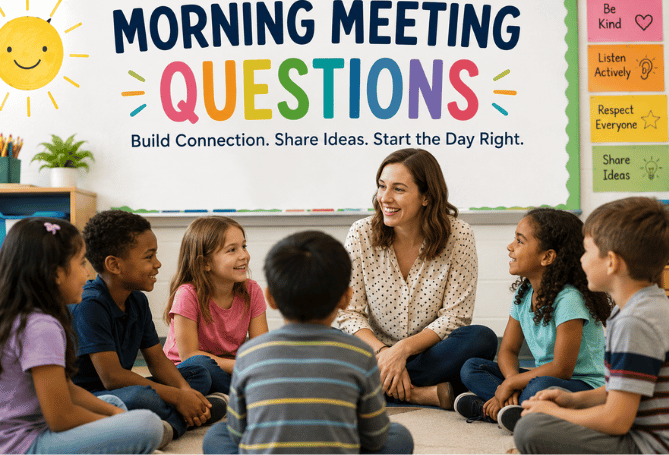
The right morning meeting questions can help students settle in, learn about their classmates, and prepare to participate. A strong prompt doesn’t need to be complicated. It should be easy to understand, safe to answer, and broad enough to invite more than a one-word response.
Use the 100 prompts below for daily check-ins, classroom circles, advisory periods, or social-emotional learning activities. You can choose a light question for a busy morning or a reflective one when students need time to slow down and reconnect.
| Morning Meeting Questions | Recommendation |
| Best age range | Elementary through high school |
| Suggested time | 5–15 minutes |
| Ideal answer length | 20–60 seconds |
| Best group size | Whole class or groups of 4–8 |
| Helpful format | One prompt per session |
| Important rule | Students may pass without explaining |
| Main purpose | Build connection, reflection, and communication |
How to Use Morning Meeting Questions Effectively

Display one question where everyone can see it. Give students a few quiet seconds to think before calling for answers. This small pause helps learners who need more processing time and often produces more thoughtful responses.
You can ask students to respond in several ways:
- Share aloud with the whole class.
- Discuss the question with a partner.
- Write an answer on a sticky note.
- Post a response on a digital discussion board.
- Draw an answer before explaining it.
- Vote by moving to different areas of the room.
Answer the question first when you introduce the routine. Your example shows students how much detail to provide and what kind of response is appropriate.
For new groups, begin with the light prompts in the first sections. Thinkomics’ collection of fun icebreaker questions offers more low-pressure options for students who are still getting comfortable with one another.
Quick Questions to Start the Day
These prompts are simple enough for a fast check-in. They work well when you have only a few minutes or want every student to participate. Our related guide, How to Work in a Corporate Job, goes further into this.
- What are you looking forward to today?
- What is one word that describes your mood?
- What is one thing you hope goes well today?
- What did you enjoy most about yesterday?
- What is one small goal you have for today?
- Which part of the school day do you enjoy most?
- What is something that made you smile this morning?
- What is one thing you want to remember today?
- Would you rather start with reading, art, science, or math?
- What would make today feel successful?
Fun and Silly Questions
A playful question can bring energy into the room without asking students to reveal private information.
- If your backpack could talk, what would it say?
- Which animal would make the funniest teacher?
- What food would make the worst ice cream flavor?
- If you could rename Monday, what would you call it?
- Would you rather have a pet dinosaur or a pet dragon?
- What would your superhero name be?
- If your shoes had a special power, what would it be?
- Which classroom object would win a talent show?
- If you could invent a holiday, what would people celebrate?
- What would you put in a sandwich made for an alien?
Would-You-Rather Questions
“Would-you-rather” prompts give hesitant students two clear starting points. Ask them to explain their choice when time allows.
- Would you rather explore the ocean or outer space?
- Would you rather read minds or become invisible?
- Would you rather be able to fly or breathe underwater?
- Would you rather have an extra hour before school or after school?
- Would you rather create a new game or write a new story?
- Would you rather visit the past or the future?
- Would you rather work with a partner or in a small group?
- Would you rather live in a treehouse or on a houseboat?
- Would you rather give up television or video games for a month?
- Would you rather be an expert artist or an expert musician?
Questions About Favorites and Interests

Preference questions help classmates discover shared interests. They are useful when students are getting to know one another.
- What is a book you would recommend?
- What is your favorite way to spend a free afternoon?
- Which school subject interests you most?
- What song improves your mood?
- What is your favorite season, and why?
- Which meal could you eat every week?
- What game do you enjoy playing with other people?
- What is your favorite place to relax?
- Which fictional character would you like to meet?
- What hobby would you like to try?
Questions About Learning
These prompts help teachers understand how students approach learning. They can also reveal practical ways to adjust lessons and support participation.
- What helps you concentrate?
- What makes a lesson interesting?
- When do you feel most confident in class?
- What do you do when an assignment feels difficult?
- Do you learn better by reading, listening, discussing, or practicing?
- What is one topic you would like to understand better?
- What question do you wish teachers asked more often?
- What skill have you improved this year?
- What is something useful you learned outside of school?
- What makes group work successful?
Responses to these questions can guide later instruction. Teachers who want more ways to check students’ understanding can review these formative assessment examples.
Goal-Setting Questions
Goal prompts help students connect a broad ambition with one manageable next action.
- What is one goal you have for this week?
- What is one habit you want to improve?
- What is a small step you can take today?
- What would you like to feel proud of by Friday?
- Which skill would you like to practice more?
- Who could help you reach a current goal?
- What might distract you from your plan?
- How will you know that you made progress?
- What is one goal you have already reached?
- What did reaching that goal teach you?
Avoid turning every response into a public promise. Some students may prefer to write their goals privately or share them with a partner.
Kindness and Classroom Community Questions
Use these prompts to help students notice how their actions affect others.
- What does kindness look like in a classroom?
- How can you help someone feel included today?
- What makes you feel welcome in a group?
- What is one kind thing someone did for you recently?
- How can classmates disagree respectfully?
- What should you do when someone is left out?
- How can we make it easier for people to ask for help?
- What does being a good listener involve?
- How can you encourage someone who is struggling?
- What classroom rule helps people feel safe?
Treat these questions as invitations to reflect, not tests with a single correct response. Listen for practical ideas that students can apply during the day.
Gratitude and Positive Reflection Questions
Gratitude prompts work best when they stay specific. Students shouldn’t feel pressured to describe serious personal experiences.
- What is one small thing you appreciate today?
- Who helped you recently?
- What is something your class does well?
- What place makes you feel comfortable?
- What is one ability you are glad to have?
- Which part of yesterday went better than expected?
- What is something in nature you enjoy noticing?
- What object do you use every day and appreciate?
- What is one opportunity you are thankful for?
- What is something a friend or classmate taught you?
Problem-Solving Questions

These questions encourage flexible thinking without putting a student’s real conflict on public display.
- What is the first thing you do when a plan fails?
- How can you make a large task feel manageable?
- What can you do when two people want different things?
- How do you decide whether to ask for help?
- What makes feedback useful?
- What can you learn from a mistake?
- How can a group make a fair decision?
- What helps you remain calm during a difficult task?
- What is one way to try a problem differently?
- How can you respond when you don’t know the answer?
Some of these prompts can become student-selected activities. A classroom choice board can give learners different ways to reflect, write, draw, or discuss their responses.
End-of-Week Reflection Questions
Friday or end-of-cycle prompts help students notice progress instead of focusing only on finished grades.
- What is something you learned this week?
- What was your proudest moment?
- What challenged you?
- What mistake helped you learn?
- Who supported you this week?
- What is something you would do differently next time?
- Which activity helped you learn the most?
- What question are you still thinking about?
- What are you looking forward to next week?
- What is one success you want to celebrate?
How to Choose the Right Question
Match the prompt to the class’s energy, trust level, and available time.
| Classroom situation | Suitable question type |
| Students are quiet or new | Favorites and simple choices |
| The class feels low-energy | Funny or imaginative prompts |
| Students seem distracted | Quick plans and daily goals |
| A group task is coming | Cooperation and listening |
| Students faced a setback | Problem-solving and reflection |
| The week is ending | Progress and celebration |
Begin with topics that have low emotional risk. Food, hobbies, imaginary situations, school preferences, and everyday plans usually give students room to participate without exposing private information.
More personal prompts may be appropriate after trust develops, but students should always be able to pass. Avoid demanding public answers about family conflict, money, health, religion, trauma, romantic relationships, or disciplinary matters.
Ways to Keep the Routine Engaging
Repeating the same format every day can make even good questions feel stale. Change how students respond while keeping the underlying routine predictable.
Try one of these variations:
- Turn and talk: Students share with one partner.
- Four corners: Each area represents a possible answer.
- Anonymous notes: Read selected responses without names.
- Sketch first: Students draw before speaking.
- Pass the object: Only the person holding an object speaks.
- One-sentence round: Everyone keeps the answer brief.
- Student host: A learner selects and reads the prompt.
- Follow-up day: Revisit a strong answer or idea later.
Common Mistakes to Avoid
Asking several questions at once
Choose one clear prompt. Multiple parts make the activity harder to follow and often lead to longer, unfocused responses.
Requiring every student to speak publicly
Participation can include writing, drawing, using the chat, or sharing with a partner. A pass option protects student comfort and builds trust.
Correcting personal answers
The purpose is connection and reflection. Don’t debate a student’s preference or turn every answer into an academic correction.
Letting the activity run too long
A class check-in should support the day’s learning rather than replace it. Set a response limit or use small groups when the class is large.
Beginning with sensitive subjects
Start with low-pressure topics. Students may not know one another well enough to discuss personal fears, family life, or difficult experiences safely.
Using questions without listening
Pay attention to patterns. If several students say they feel confused, rushed, or excluded, decide whether the class routine needs an adjustment.
Conclusion
Morning meeting questions are a simple but effective way to build stronger classroom relationships, improve communication, and create a welcoming learning environment. By choosing age-appropriate, open-ended prompts and giving every student the option to participate in a way that feels comfortable, teachers can encourage confidence, active listening, and meaningful conversations. For the full picture, read improve kids handwriting.
Rotating between fun, reflective, goal-setting, and problem-solving questions keeps the routine fresh while supporting students’ social and emotional growth. Over time, these daily check-ins help create a positive classroom community where every student feels respected, connected, and ready to learn.
Apart from that, if you want to know about articles,High-Paying Jobs in 2026, then please visit our Career Advice Category.
Frequently Asked Questions
The best prompts are short, open-ended, and suitable for the students’ age and comfort level. Questions about favorites, goals, creative choices, learning preferences, and small successes usually work well. A student should be able to answer without revealing private information.
One question is usually enough. A single prompt gives students time to think and lets the teacher keep the activity focused. Use partner discussions or small groups when everyone needs a chance to respond.
Most classroom check-ins can last between five and fifteen minutes. Set a shorter limit when the class has many students or the day’s schedule is tight.
Yes. Students should be able to pass without explaining their decision. Giving them that choice lowers pressure and can make future participation more likely.
Yes. Older students often respond well to questions about goals, decision-making, learning preferences, current interests, and hypothetical situations. Avoid using language that sounds designed for much younger children.
Provide thinking time before asking for answers. Let students write, draw, use a digital form, or speak with one partner. These choices make participation more accessible without putting anyone on the spot.
Create a Routine Students Trust
A useful class check-in is brief, predictable, and respectful. Pick one question, model a suitable answer, and give students time to think. Let them share in a format that feels manageable. Save this list, rotate among the categories, and notice which prompts to produce genuine conversation. The goal isn’t to collect perfect answers. It is to help students feel seen, practice listening, and begin learning as a connected group.