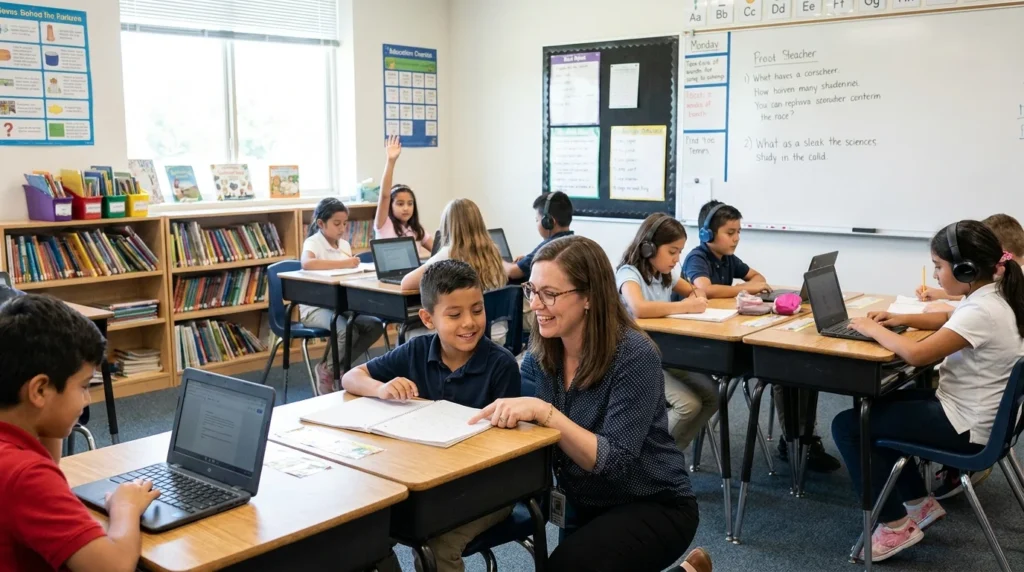

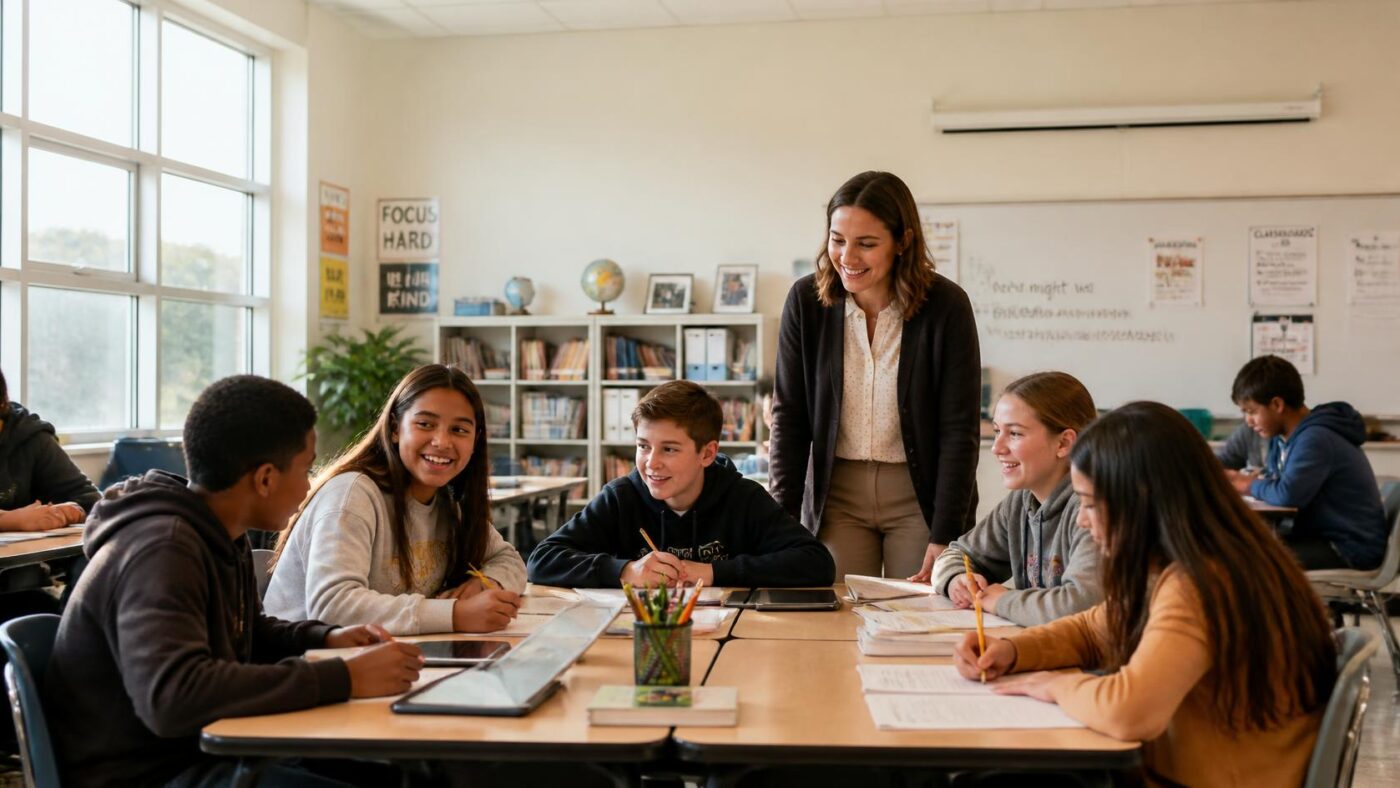
Say the phrase in a staff meeting and half the room pictures chaos. That picture is wrong. Student centered learning hands specific decisions to students while the teacher keeps control of the goal, the standard, and the evidence. We cover this in more depth in classroom management strategies.
Short answer: It is an approach where learners help decide how they work, what they produce, and how quickly they move. The teacher still sets the objective and checks what was learned. In practice it looks like structured choice, goal setting, discussion, and feedback. It does not look like a room without a plan.
At A Glance
| Question | Short answer |
| What it really is | A shift in who makes classroom decisions, not a new curriculum |
| What stays with the teacher | The learning goal, the standard of quality, and the check for understanding |
| What moves to students | Method, product, pacing, grouping, and reflection |
| Cheapest first step | Offer two ways to show the same skill in one lesson |
| Planning time to expect | About 30 extra minutes for the first lesson, then less |
| Biggest risk | Handing choice to students who lack the background knowledge yet |
Key Takeaways
- Choice is the visible part. Shared responsibility for the goal is the real part.
- Beginners still need explicit teaching first. Choice comes after the foundation.
- One rubric, several products. That is how grading stays fair and fast.
- You can test the whole idea inside one existing unit in five days.
What Student Centered Learning Means in Practice?
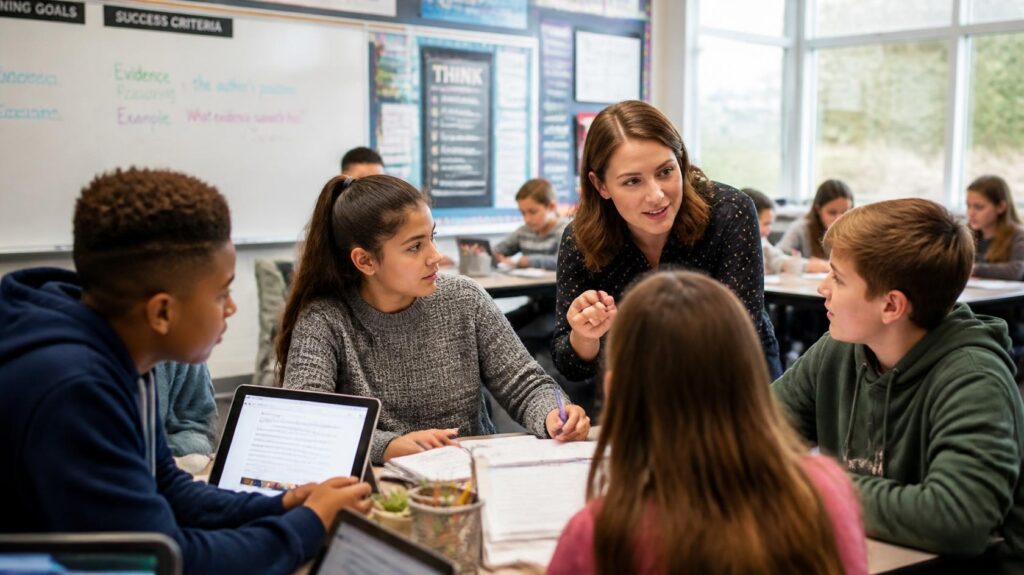
Every lesson contains a stack of decisions in Student centered learning. Someone picks the goal. Someone picks the task, the grouping, the pace, and the way students prove they got it. In a traditional lesson the teacher makes all of them. In a learner-centered lesson, some of those decisions move across the room.
The goal never moves. Neither does the standard. A fifth grader who chooses to explain fractions with a drawing instead of a paragraph still has to be right about fractions.
Here is the distinction page one keeps skipping. Guided choice is not unguided discovery. Novices asked to invent a method from scratch usually invent a wrong one, and they hold onto it. So the sequence matters: teach the idea clearly, practice it with support, then open up the decisions. Choice belongs after the foundation, not instead of it. If you want the raw material for that first stage, start with the instructional methods behind those lessons and pick the one that fits your objective.
Four things typically shift:
- Talk. Students explain their reasoning more than the teacher does.
- Product. Several formats can prove the same skill.
- Pace. Students who have it move on. Students who do not get more practice.
- Reflection. Learners judge their own work against the rubric before you do.
Student Centered Vs Teacher Centered Instruction
These two labels are not opposites on a switch. They sit on a dial, and most good lessons move along it more than once. This table shows where the dial turns.
| Decision | Teacher centered instruction | Learner-centered lesson |
| Learning goal | Teacher sets it | Teacher sets it, students restate it in their own words |
| Order of tasks | Fixed for the class | Students choose a path through a set menu |
| Evidence of learning | One assigned product | Several products, one rubric |
| Pace | Whole class together | Checkpoints instead of a single deadline |
| Feedback | Teacher to student | Self, peer, then teacher |
| Who talks most | The teacher | The students |
What The Research Shows
Most guides on this topic make the claim and then attach nothing to it. No study, no sample size, no effect size, no real numbers. Here is one you can check.
A 2014 meta-analysis of 225 studies appeared in the Proceedings of the National Academy of Sciences. Average exam scores rose by roughly 6% when undergraduate science and math courses replaced straight lecturing with active learning, an effect size of 0.47 standard deviations. Failure rates fell from 33.8% under traditional lecturing to 21.8%. Students in lecture-only classes were about 1.5 times more likely to fail.
Read that honestly. Those students were college undergraduates in STEM, not third graders, so the figures do not transfer directly to a K-12 classroom. What it does establish is that giving students something to do with the content, rather than something to watch, improves measured achievement. That is the mechanism learner-centered teaching runs on.
Six Examples You Could Run Tomorrow
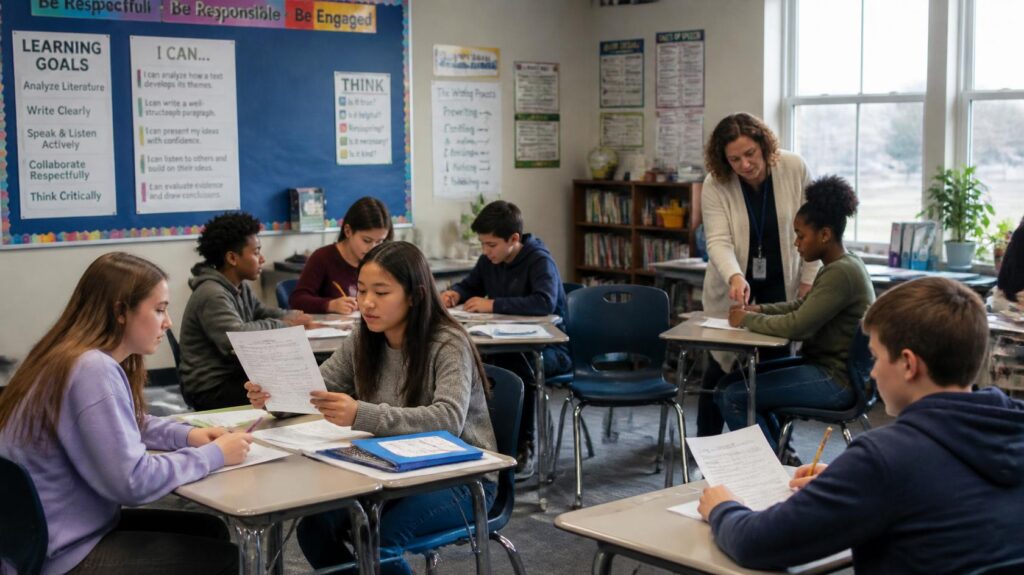
Grade level changes what this looks like for Student centered learning, and almost no guide separates them. These six are ordered from youngest to oldest.
- Elementary, show it your way. After a lesson on the water cycle, students pick a labeled diagram, a short comic, or a spoken explanation recorded on a tablet.
- Elementary, reading corner votes. The class picks the next read-aloud from three titles you preselected, then explains the choice in one sentence.
- Middle school, task menu. Six aligned activities, students complete three. You can build a choice board in about twenty minutes and reuse the grid all year.
- Middle school, question bank. Students write the review questions for the unit test. You select the strongest eight and tell them which ones made the cut.
- High school, evidence seminar. Students prepare positions on a document, run the discussion themselves, and you track participation from the back of the room.
- High school, project contract. Each student proposes a product, a deadline, and the rubric row it will be scored against. You approve or send it back.
A One Week Plan That Fits Your Existing Curriculum
Forget new software, a purchase order, or a redesigned unit. The five days below cost $0 beyond paper you already have. Take a lesson you teach every year and run this.
- Monday. Teach the content the way you normally would. Change nothing.
- Tuesday. Write the objective on the board and ask students to rewrite it in their own words. Collect the slips. The muddled ones tell you where to reteach.
- Wednesday. Offer two ways to practice the same skill. Two, not eight. Announce that both are scored on the same rubric.
- Thursday. Have students swap work and mark one rubric row on a partner’s piece. This is also where stronger critical thinking habits get practiced, since they have to justify the score.
- Friday. Ask two questions: what did you choose, and would you choose it again? Keep the answers. They are your planning notes for the next unit.
Expect about thirty extra minutes of prep for Wednesday. After the first cycle the same rubric and the same menu carry forward.
Grading Work When Students Pick Different Products

This is the question that stops most teachers, and page one almost never answers it. Score the thinking, not the format.
Write one rubric for the standard. A comic, an essay, and a recorded explanation can all be judged on accuracy, use of evidence, and clarity. None of those rows mention what the product is made of.
- Cap the options. Three to six, all aligned to the same rubric rows.
- Set a floor. Every option must include the same required element, such as three pieces of evidence.
- Grade blind to format. Read the rubric row, not the medium, and score every student on that row before moving to the next.
Grading blind to format also stops the quiet drift where the poster always outscores the paragraph.
Five Signs It Is Working
Busy is not the same as learning. A room can hum and produce nothing, which is why a checklist that stops at “students are engaged” is useless. Watch for five observable signals that tell you the shift is working:
- Students describe the goal without looking at the board.
- Questions to you shift from “is this right?” to “does this count as evidence?”
- Work quality holds steady across the different product options.
- Students revise before submitting, unprompted.
- Your exit data improves. Simple quick formative checks at the door will show it within two weeks.
Where This Approach Goes Wrong

In Student-centered learning, four failure modes account for most disappointing attempts, and they are all predictable.
Choice paralysis. Nine options is not generosity. It is a stall. Three is usually plenty for a first attempt.
The easiest lane. Students will pick the shortest option unless the rubric makes effort visible. Equal difficulty across options is a design job, not a hope.
One person doing the thinking. Group work without individual accountability rewards the loudest student. Give every member a named role and a product with their name on it.
Thin classroom culture. Voice needs safety first. Students will not risk a wrong answer in a room where wrong answers get laughed at, so daily social emotional learning activities are the groundwork, not a nice extra.
Start With One Lesson
Pick a lesson you have taught many times and know cold. Offer two ways to prove the skill on Wednesday. Score both with one rubric. If the work holds up, widen it to a unit next month. That is the whole on-ramp.
Frequently Asked Questions
No. The teacher still sets the objective, the rubric, and the deadline. Students choose the route, not the destination.
Designer first, then coach. You build the options, teach the foundation explicitly, circulate while students work, and
Yes, with tighter limits. Kindergarten choice might be two stations rather than six. The skill being practiced is decision making, and it scales with age.
Personalized learning usually adjusts pace and difficulty for each student, often through software. This approach is broader and asks students to help make the decisions rather than receive an adjusted version of them.
Usually yes. A script governs content and sequence. It rarely dictates how students practice or what they hand in, and that is where the room to shift lives.