
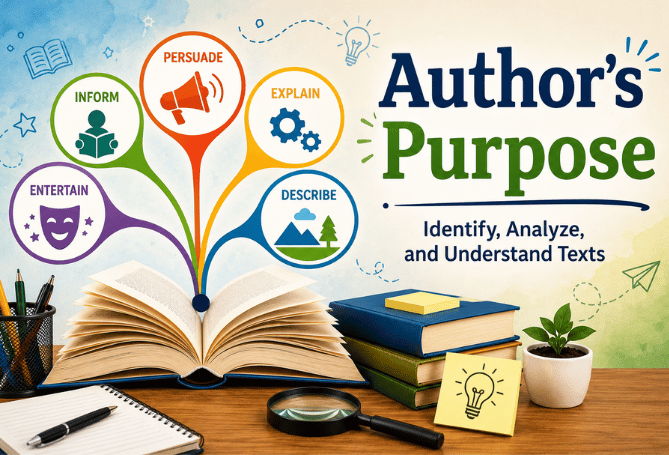
The author’s purpose is the main reason a writer creates a text. The writer may want to inform you, persuade you, entertain you, explain an idea, or describe something. You can identify that reason by examining the text’s language, evidence, structure, tone, and intended audience. Understanding why a text was written helps you read it more carefully. It also helps you recognize opinions, judge evidence, notice bias, and explain a passage in your own words.
| Author’s purpose | What to look for |
| What does the writer want the reader to do? | Calls to action, recommendations, or persuasive language |
| What does the writer want the reader to learn? | Facts, definitions, examples, or instructions |
| What does the writer want the reader to feel? | Humor, suspense, emotion, or vivid storytelling |
| Who is the intended reader? | Vocabulary, examples, tone, and level of detail |
| What evidence supports the purpose? | Facts, opinions, quotations, descriptions, or story events |
What Does an Author’s Purpose Mean?
A writer’s purpose is the result they hope to achieve through a piece of communication. It answers a simple question: Why did the writer create this text? A purpose can be broad or specific. For example, a broad goal might be to persuade. The specific goal might be to convince parents that students should receive less homework.
Purpose affects almost every writing decision. Purdue OWL explains that communication goals influence the topic, audience, medium, and other choices a writer makes. Writers may seek to instruct, educate, persuade, inform, entertain, excite, or comfort their audience.
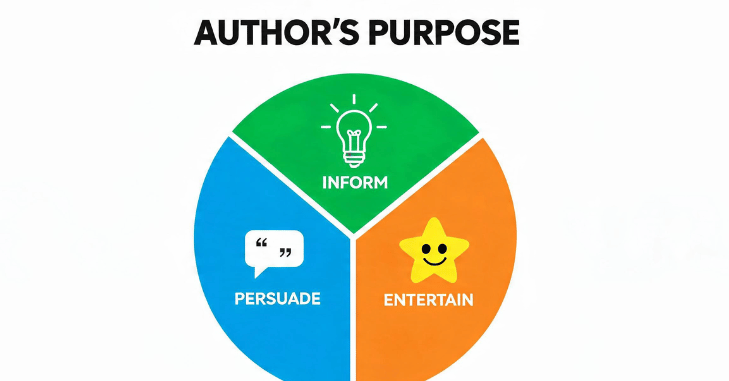
Many school lessons use three basic categories: persuade, inform, and entertain. This model is often remembered through the acronym PIE. Broader teaching frameworks add explanation and description, creating five useful categories.
The Five Main Purposes of Writing
To persuade
A persuasive writer wants the reader to accept an opinion, support a position, or take an action.
Common persuasive texts include:
- Advertisements
- Opinion columns
- Campaign speeches
- Product reviews
- Fundraising letters
Look for claims, supporting reasons, emotional appeals, recommendations, and calls to action. Persuasive writing may include facts, but those facts usually support a particular viewpoint.
Example: A school newspaper editorial argues that the cafeteria should offer healthier meals. It presents nutrition facts and asks school leaders to change the menu.
To Inform
An informative writer gives readers facts or knowledge about a subject. The main goal is to help the audience understand what something is, where it happened, or what is known about it.
Common examples include:
- Textbooks
- News reports
- Encyclopedias
- Biographies
- Reference articles
Informative passages often use definitions, dates, statistics, headings, diagrams, or factual descriptions. Their tone is usually neutral, though readers should still check for selective evidence or hidden bias. Study.com notes that understanding a writer’s goal supports text analysis and information retention. It also encourages readers to consider what information was included or excluded.
To Entertain
A writer who aims to entertain wants to hold the audience’s attention or create an emotional experience.
Examples include:
- Novels
- Short stories
- Plays
- Comics
- Humorous essays
- Narrative poems
These texts may include characters, conflict, dialogue, suspense, humor, or imaginative settings. Entertainment does not prevent a story from serving another goal. A novel can entertain readers while teaching them about history or encouraging them to reconsider a social issue. Writers often combine purposes rather than using only one.
To Explain
Explanatory writing shows how or why something happens. It often breaks a process, idea, or cause-and-effect relationship into clear parts.
Examples include:
- How-to articles
- Science explanations
- Instruction manuals
- Recipes
- Tutorials
- Frequently asked questions
A passage explaining how rain forms has a different focus from one listing facts about rainfall. The first explains a process. The second mainly informs. Explanatory texts often contain sequence words such as “first,” “next,” “because,” and “as a result.”
To Describe
Descriptive writing helps the reader picture, hear, smell, taste, or feel something.
You may find it in:
- Travel writing
- Personal essays
- Poetry
- Fiction
- Nature writing
- Product descriptions
A descriptive passage relies on sensory details and carefully chosen words. Its goal may be to create a clear image, establish a mood, or make an experience feel real. Description often supports another purpose. An advertisement may describe a beach resort to persuade readers to book a holiday. A novelist may describe a dark house to entertain readers and build suspense.
How to Identify an Author’s Purpose in Five Steps

Identify The Type Of Text
Start with the genre or format. A news report will often inform. An advertisement will usually persuade. A short story will often entertain. A manual will explain how to complete a task. Genre gives you a useful starting point, but it does not provide the answer by itself. A biography may inform and entertain at the same time.
Find The Main Topic And Central Idea
Ask what the passage is mainly about. Then determine what the writer says about that subject.
The topic might be recycling. The central idea might be that households can reduce waste by separating paper, glass, and food scraps.
Knowing the central idea helps you distinguish the subject from the writer’s goal.
Examine The Evidence And Details.
Different goals tend to produce different forms of evidence.
| Evidence or feature | Likely purpose |
| Facts, dates, and definitions | Inform |
| Reasons, claims, and calls to action | Persuade |
| Characters, conflict, and dialogue | Entertain |
| Steps, causes, and processes | Explain |
| Sensory details and imagery | Describe |
Study The Tone And Language
Tone shows the writer’s attitude toward the topic. A serious, factual tone may suggest an informative goal. Urgent or emotional wording may signal persuasion. Playful language may support entertainment. Tone alone is not enough. A persuasive article can sound calm and factual. Connect the tone to the evidence and message.
Ask What Response The Writer Wants
Complete this sentence:
“After reading this, the writer wants me to _____.”
Possible answers include:
- Understand a fact
- Agree with a claim
- Take an action
- Enjoy a story
- Learn how something works
- Picture a person or place
This question shifts your attention from the topic to the intended effect on the reader.
For more study strategies and reading support, visit the Thinkomics Student Guides section.
Worked Examples
A Recycling Poster
“Place plastic bottles in the blue bin. Recycling keeps reusable materials out of landfills.”
The main goal is to persuade readers to recycle. The instruction and benefit support a desired action.
A Volcano Article
“Pressure builds beneath Earth’s surface until magma rises through cracks in the crust.”
The passage explains how an eruption begins. It presents a process rather than arguing for an opinion.
A Mystery Story
“Maya heard the floorboard creak, but everyone else was asleep.”
The writer aims to entertain by creating suspense and encouraging the reader to continue.
A Rainforest Passage
“Warm mist hung between broad green leaves while insects clicked in the shadows.”
The main aim is to describe the setting through sensory detail. The description may also help entertain the reader.
Primary And Secondary Purposes

A passage can serve more than one goal. A documentary may educate viewers while entertaining them. A charity advertisement may inform readers about a problem before asking for a donation. A historical novel may tell an engaging story while teaching readers about a past period.
When purposes overlap, identify the primary purpose by asking which result matters most. Is the writer mainly trying to change your behavior, teach you facts, or create an experience? Then name a secondary purpose when the evidence supports it.
A strong response might say the following:
“The writer’s main purpose is to persuade readers to conserve water. A secondary purpose is to inform them about household water use.”
Common Mistakes to Avoid
Confusing The Topic With The Purpose
“Climate change” is a topic. “To persuade readers to reduce carbon emissions” is a purpose.
Choosing A Purpose Based Only On Genre
Fiction often entertains, but it can also persuade, criticize, or teach. A factual article may quietly promote one viewpoint.
Use the passage itself as evidence.
Ignoring The Intended Audience
A safety guide written for children will use different examples and vocabulary from one written for engineers.
Audience clues help explain the writer’s choices.
Giving Evidence Without Explaining It
Do not write, “The passage contains facts.” Write, “The writer uses facts about food waste to inform readers about how much edible food households discard.” The second response connects the evidence to the goal.
Students preparing for reading tests can also browse Thinkomics’ exam preparation section. Learners studying remotely may find the online learning category relevant as the site expands.
A Simple Answer Formula
Use this structure in an assignment or exam: “The writer’s main purpose is to [purpose] the reader by [specific goal]. This is shown through [evidence from the text].”
Example:
“The writer’s main purpose is to persuade readers to adopt a pet. This is shown through positive descriptions of rescued animals and a direct request to visit the shelter.”
This formula names the purpose, makes it specific, and supports the conclusion.
Conclusion
Understanding the author’s Purpose is one of the most valuable reading skills students can develop. Once you know how to identify whether a writer wants to inform, persuade, entertain, explain, or describe, you can analyze texts more accurately and think more critically about the information you read.
By examining the writer’s tone, evidence, language, audience, and overall message, you can confidently determine the Author’s Purpose behind any passage. Practicing these strategies across different types of writing will strengthen reading comprehension, improve text analysis, and help you become a more thoughtful, informed reader in both academic and everyday situations.
Apart from that, if you want to know about the article “Microaggression Examples,” then please visit our Education Category.
Frequently Asked Questions
The three traditional types are to persuade, inform, and entertain. Teachers often use the acronym PIE to help students remember them. Some frameworks also include explaining and describing.
Informing presents facts about a topic. Explaining shows how or why something happens, often through steps, causes, or processes.
Yes. A text may have a primary and secondary goal. A speech might inform an audience about a problem before persuading them to support a solution.
Yes. A text may have a primary and secondary goal. A speech might inform an audience about a problem before persuading them to support a solution.
No. The main idea tells you what the text says. The purpose tells you why the writer wrote it