

The job application meme turns an ordinary employment form into a terrifying surprise. It’s usually aimed at someone acting “chronically online,” with the joke suggesting that finding work is their greatest fear. The format began years before its major TikTok surge, but short videos helped turn it into one of the internet’s most recognizable employment jokes.
| Quick fact | Answer |
| Main joke | A job application is presented as a frightening object |
| Other names | Job application jump scare, employment form meme |
| Earliest documented version | A Halloween post from October 2019 |
| Major viral period | Spring 2025 |
| Popular platforms | TikTok, X, Reddit and meme-sharing sites |
| Typical target | Someone jokingly portrayed as unemployed or chronically online |
| Common formats | Jumpscare videos, reaction images and edited game clips |
Direct answer: The meme means, “Stop spending all your time online and get a job.” A blank employment form appears without warning as a mock jump scare. Its humor comes from treating normal adult responsibility as though it were a monster, curse, or other frightening threat.
What Does the Job Application Meme Mean?

At its simplest, the joke is an exaggerated version of telling someone to “get a job.” A user may post an odd comment, spend hours arguing online, or demonstrate unusually deep knowledge of internet drama. Someone else responds with a picture of an employment form. The implication is that the first person has too much free time and should look for work.
The joke doesn’t require the person to be unemployed. Friends with full-time jobs may send it to one another because the format is absurd. The humor depends on pretending that an ordinary piece of paperwork is terrifying.
That’s also why the form often appears with:
- A loud scream or dramatic sound effect
- Horror-game music
- A sudden zoom toward the screen
- A warning not to say the word “job”
- Captions such as “Did I scare you?”
- Mock censorship such as “j*b” or “employment”
Users have described the image as an internet version of “go outside” or “touch grass.” It’s less about serious career advice and more about teasing someone for being deeply invested in online culture.
Where Does the Job Application Meme Come From?

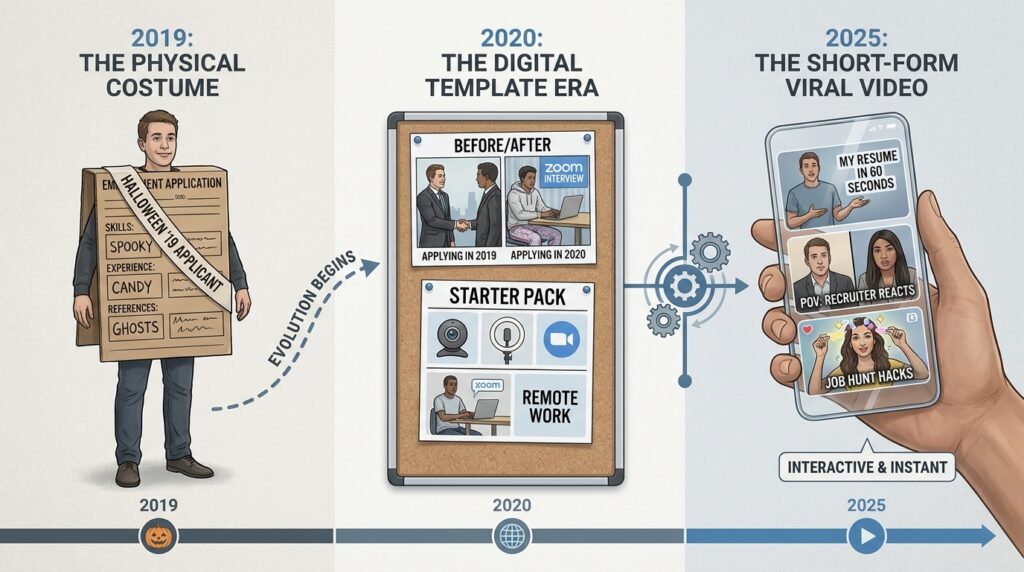
The earliest widely documented version appeared on X, formerly Twitter, on October 31, 2019. The post showed a man wearing an employment form as a Halloween mask. Its caption joked that the form would frighten many viewers. The idea worked because it reversed expectations: instead of using a monster costume, the creator presented adult responsibility as the real horror.
In May 2020, an employment-form template appeared on Imgflip. That gave other users an easy image to edit, caption, and reuse. The format continued circulating in different forms before its larger social-media breakthrough. an be divided into three stages:
| Stage | Period | What happened |
| Early joke | October 2019 | A Halloween post framed an employment form as something frightening |
| Reusable template | May 2020 | A form template became available for new captions and edits |
| Viral revival | Spring 2025 | TikTok creators used the form in jumpscares, game clips and reaction videos |
This slow development is common in meme culture. A simple joke may circulate for years before a new platform, sound, or editing style gives it a much larger audience.
Why Did the Job Application Meme Go Viral?
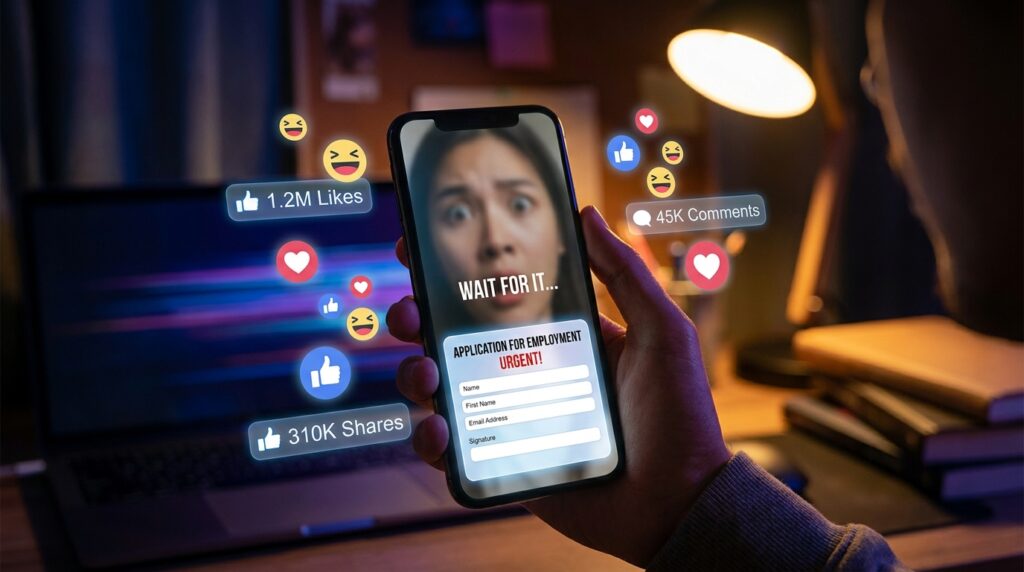
TikTok made the joke faster, louder, and easier to understand. A still image can be funny, but a short video can build tension before suddenly revealing the form. Creators began inserting it into horror clips, gaming footage, cartoons, and dramatic scenes. Viewers understood the punchline almost instantly, even when a video contained no explanation.
One TikTok version posted in March 2025 reportedly gained more than three million plays within three months. Another creator edited the form into a scene from Invincible, replacing a threatening character with the document. These videos helped establish the “jumpscare” version as the dominant format. It benefited from four useful qualities.
It has a clear visual punchline
Most people recognize an employment form immediately. The viewer doesn’t need to know a character, television show, or complicated backstory.
It works in almost any video
The form can replace a monster, villain, warning screen, or surprise ending. Creators can insert it into existing clips with minimal explanation.
It invites participation
People can create new versions with a screenshot, basic editing software, or a printed form. That low barrier helps a format spread.
It exaggerates a relatable feeling
Looking for work can involve long forms, repeated questions, and uncertain outcomes. Turning that process into a horror scene gives people a silly way to acknowledge genuine frustration.
Readers who want a break from serious applications can also browse Thinkomics’ collection of fun, free and productive boredom ideas. The connection is fitting: according to the meme, having too much free time is exactly what makes an employment form so frightening.
Common Versions of the Job Application Meme
Although the central joke stays the same, creators use several formats.
| Version | Setup | Punchline |
| Classic “Boo” image | A normal post or Halloween joke | A form appears as the scary object |
| Video jumpscare | A calm or suspenseful clip | The form suddenly fills the screen |
| Reaction reply | Someone posts an extremely online opinion | Another user replies with the form |
| Horror-game edit | A player approaches a door or enemy | Employment paperwork appears |
| Censored-word joke | Someone writes “job” or “work” | Replies act shocked that the word wasn’t censored |
| Printed-form prank | A physical form is handed to someone | Their surprise becomes part of the joke |
The printed version has even moved beyond screens. In February 2026, one Reddit user described handing out humorous application forms at an anime convention in Lahore. Some attendees understood the joke at once, while others thought a real job was being offered. That confusion shows how much the format depends on shared internet context. Joke Funny?
The humor comes from incongruity, which occurs when an outcome sharply contradicts what the audience expects.
A jump scare should reveal a ghost, attacker, or monster. Revealing office paperwork instead is ridiculous. The form is safe and ordinary, yet everyone in the video reacts as though it’s dangerous.
The format also uses playful role reversal. Employment normally represents responsibility and stability. In the meme, it becomes a threat to a carefree online existence.
A typical version follows this structure:
- Establish a familiar or calm situation.
- Suggest that something frightening is approaching.
- Reveal the employment form.
- Treat the viewer’s supposed unemployment as the punchline.
The joke is strongest when the audience recognizes both the horror convention and the online stereotype being mocked.
For more ways to keep group humor light rather than personal, Thinkomics’ guide to fun icebreaker questions for work and school offers safer prompts for conversations and activities.
Is the Meme Insulting?
It can be. Among friends, the joke may be harmless because everyone understands the tone. In a public reply, it can sound like an accusation that someone is lazy, unemployed, or wasting their life.
That distinction matters because unemployment isn’t always a choice. People may be applying repeatedly, managing a disability, studying, caring for relatives or facing a difficult labor market. Sending them an employment form may turn a playful format into a personal insult.
A simple rule helps: make the situation the target, not a person’s real hardship.
Safer uses include:
- Responding to your own long gaming session
- Teasing a friend who already enjoys the format
- Editing the form into fictional horror footage
- Joking about procrastinating on your own résumé
- Using it to parody unrealistic job postings
Avoid directing it at someone who has disclosed financial stress or a difficult employment search. When tone is uncertain, another reaction image is the better choice.
Thinkomics’ guide to understanding and naming emotions can also help readers recognize why the same joke may feel playful to one person and discouraging to another.
What Does the Meme Say About Online Culture?
The trend reflects the internet’s habit of turning uncomfortable experiences into shared jokes. Employment searches can be repetitive and emotionally draining. Online communities often deal with that tension through exaggeration. Instead of saying, “Applying for work makes me anxious,” the meme imagines the application itself as a horror villain.
It also reflects the stereotype of the “chronically online” user. This person supposedly knows every niche argument, meme, and platform controversy because they have no offline responsibilities. Showing them an employment form becomes a visual command to log off and rejoin everyday life.
That stereotype is rarely a reliable description of a real person. It works as a meme because it compresses a complicated social judgment into one recognizable image.
How Long Will the Trend Last?
The most intense wave may fade, but the basic joke is likely to remain reusable. Its visual structure is simple, and the setup can adapt to new games, shows, and social platforms. The image also works without a specific celebrity or current event. Those qualities give it a longer life than formats tied to one news story.
Future variations may change the paperwork, sound effect, or surrounding video. The central contrast will probably stay the same: normal responsibility presented as supernatural horror.
The Bottom Line
An ordinary employment form became funny because internet users treated it as the last thing an extremely online person would want to see. The joke began with a Halloween post, became a reusable template, and later found its ideal format in short jump-scare videos.
Its meaning is easy to understand: log off, face your responsibilities, and consider getting a job. Its staying power comes from presenting that familiar message through an unexpectedly dramatic image.
Explore more practical student and professional resources in Thinkomics’ Education.
Frequently Asked Questions
It’s an image or video joke that presents an employment form as a jump scare. It usually teases someone for appearing unemployed, unproductive, or overly absorbed in online culture.
They aren’t meant to be genuinely afraid. The humor comes from pretending that finding work is terrifying.
The earliest widely documented example was posted on X in October 2019. The specific format later evolved through templates, reaction images, and TikTok videos.
The video-based format grew rapidly during spring 2025, especially on TikTok. “j*b” means online? It’s a jokingly censored version of “job.” Users write it as though employment were an offensive or frightening subject.
Sometimes. It can also be self-deprecating or used among friends. The meaning depends on the context, relationship, and caption.