


Self paced learning hands the clock to the student. That works, but only when someone builds structure around it, and the structure is the part that gets skipped. This guide covers what the model really is, which students it suits, why finish rates sag, and eight rules for running it well. For the full picture, read Instructional Technology.
| Question | Short answer |
| What it is | A course where the student sets the speed and moves on after showing mastery |
| Who it suits | Learners who can plan a week, spot a stall, and ask for help |
| Who struggles | Students repeating a failed class, or anyone who needs daily prompting |
| Biggest failure mode | Backlog, caused by removing every due date |
| The fix | A weekly pacing floor plus one mastery check per unit |
| What the teacher does | Small groups, conferences and reteaching, not supervision |
| Evidence to know | 66 percent versus 78 percent credit recovery in a randomized US trial |
Key takeaways
- Self paced learning fails on backlog, not on ability.
- A pacing floor keeps the flexibility and still moves students forward.
- Gate each unit on a mastery check rather than a due date.
- The teacher’s hour shifts to small groups and reteaching.
- Grade the standard, and log pace separately.
- Plan extension work before the first fast finisher appears.
What self paced learning actually means

Self-paced learning lets a student move through a course at a speed they set. They advance when they show they understand the material, not when the calendar says so. The content is usually recorded or written. Progress rests on mastery rather than attendance, and help arrives when the student asks for it.
Delivery format is a separate question. Recorded courses can still run on a fixed weekly schedule, and a live class can still let students work ahead. If you are weighing recorded lessons against scheduled sessions, our guide to synchronous and asynchronous formats handles that decision. This piece assumes the pacing choice is already made.
Self-paced is not deadline-free
Here is the difference that decides everything else. Deadline-free courses carry no due dates at all. Self-paced ones carry a pacing floor: a minimum weekly progress target the student has to hit, with room to move faster whenever they can.
Drop the floor and the work does not spread out. It piles up.
Students read an open calendar as permission to start later, and the backlog grows quietly for a month. By week six it is too big to clear in the time left, so they quit. The floor is what keeps the flexibility honest.
Who it suits, and who it does not
Fit comes down to self-regulation, not intelligence. A student who can plan a week, notice a stall, and ask for help will do well. Students who cannot yet do those things drift, and the format usually gets blamed for it.
| Works well for | Struggles without heavy support |
| Students who already track their own due dates | Students placed in a course after failing it once |
| Adults fitting study around shift work | Learners who need daily prompting to start |
| Fast learners held back by the pace of a class | Weak readers facing a text-heavy course |
| Practice, drill and recall content | Debate, lab work and language practice |
| Anyone reviewing material they half know | Younger students still building planning habits |
Age matters less than habit, though the two travel together. Elementary students can handle short self-paced stretches with an adult nearby, and little more. Families weighing a full-time virtual school program should ask how much of the pacing the school keeps before they enroll.
The finish-rate problem, in one number
Self paced learning delivery does not carry students to the end by itself, and there is hard US evidence for that. The What Works Clearinghouse at the US Department of Education reviewed a 2017 randomized trial of 1,224 ninth graders who had failed Algebra I. Each teenager took either an online self-paced credit recovery course or a face-to-face one. Sixty-six percent of the online group recovered the credit, against 78 percent of the face-to-face group.
Researchers also reported that online students found the course harder. Same students, same content, twelve points of difference.
Read that as a warning about design, not a verdict on the model. Those teenagers were repeating a class they had already failed, which is the hardest possible case for independent work. Hand the identical format to a motivated adult and the numbers move the other way.
8 rules for running a self-paced course
- Set a pacing floor. Publish a minimum weekly progress target and check it every Friday. Faster is fine. Slower starts a conversation, not a penalty.
- Cut the course into small units. Ninety-minute chunks with a checkpoint at the end beat three-week modules, because a stalled student loses days instead of weeks.
- Gate progress on mastery. One short check at the end of each unit decides whether the student moves on or reworks the lesson.
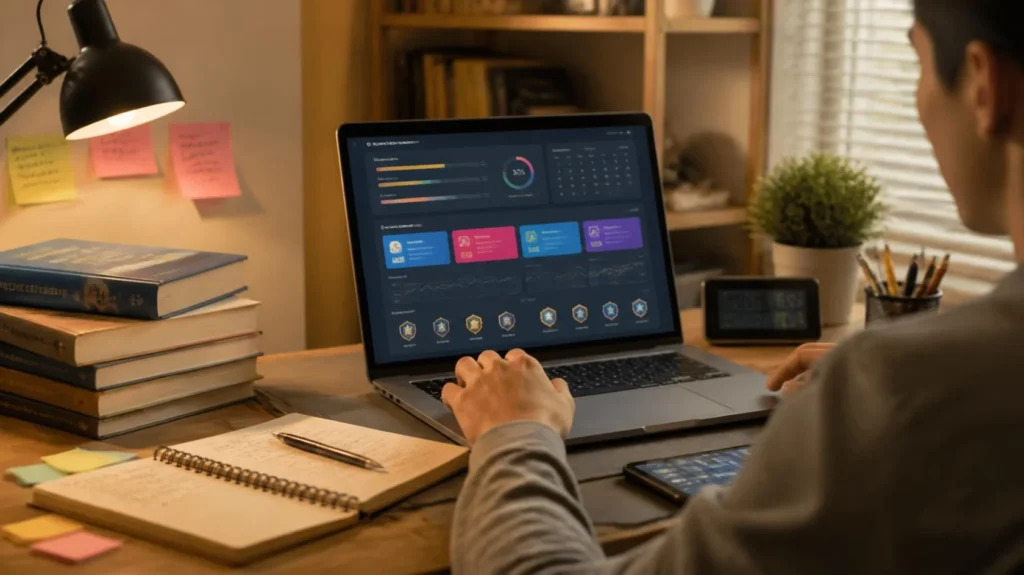
- Make the map visible. Students need to see where they are, what comes next, and how far ahead or behind they sit.
- Give real choice inside the unit. Letting students pick how they show understanding protects ownership without lowering the standard. A choice board of aligned tasks does this cleanly.
- Schedule human contact anyway. One short check-in each week does more for finish rates than any automated reminder.
- Teach the planning. Model how to read the map, estimate time and book help, then fade that support over a few weeks.
- Review the data weekly. Look at who is stalled, on which unit, and for how long. Stalls cluster, and a cluster tells you the lesson is broken rather than the student.
What the teacher does while students work
The most common misread of this model is that the adult becomes a supervisor with a clipboard. The opposite happens. Freed from delivering one lesson to thirty people at once, you spend the hour on conferences, small groups and reteaching.
Pick a target each day. Three students stuck on the same unit is a five-minute mini lesson, not thirty separate conversations. The instructional strategies you use in a taught class still apply here, aimed at smaller groups.
Grading when students sit on different lessons
This is the part that worries schools, and it is solvable IN Self paced learning. Grade the standard, not the calendar. A student who masters unit four in week three and a student who masters it in week seven have both mastered unit four.
So keep two records. Mastery is the grade. Pace is a behavior note, handled the way you would handle any late work.
Applied fairly, that split settles most of the arguments before they start, including the ones parents raise about students working on different lessons at the same time.
What fast finishers do next

Every self-paced classroom produces someone who clears the assigned work in half the time. Handing that student the next unit forever is a punishment dressed up as a reward.
Bank a set of extension tasks before you start. Depth usually beats acceleration, so a harder problem inside the same topic lands better than an early jump to the next chapter. In a math class, a stack of math enrichment problems gives fast finishers somewhere real to go.
Three signs the course is drifting
Trouble shows up in the data long before it shows up in a grade. Watch for these:
- The spread widens every week. Two units of spread in October becoming nine in December means the floor is not being enforced.
- Mastery checks pass on the second try, every time. That pattern says students are guessing until the check lets them through.
- Nobody asks for help. Silence in a self-paced room is rarely a good sign. It usually means students do not know how to ask.
Your next step
Take one unit you already teach. Split it into three checkpoints, write the mastery check for each, and publish a weekly pacing floor. Run it for two weeks, then count how many students hit the floor without a reminder from you. That number tells you how much scaffolding the rest of the course still needs.
Frequently Asked Questions
It works when the student can plan and the course has checkpoints. Compared with a taught class, results look similar for motivated learners and clearly worse for students who need daily prompting. Format is not the deciding variable. Structure is.
Backlog, mostly. Without a weekly floor the work slides toward the end, and the pile becomes unclimbable. Slow feedback and isolation finish the job.
Build your own schedule and make it visible. Pick fixed study blocks, track progress against them, and ask one person to check in with you each week. Motivation follows the routine, not the other way round.
In short stretches, yes. Elementary students can work through self-paced practice for part of a lesson with an adult nearby. Full independence usually waits until planning habits are steady, often around middle school.
Students open the map, see the unit they are on, work through the material, then take the mastery check. Pass it and they move. Miss it and they rework the lesson and retry. Meanwhile the teacher circulates and pulls small groups.
