
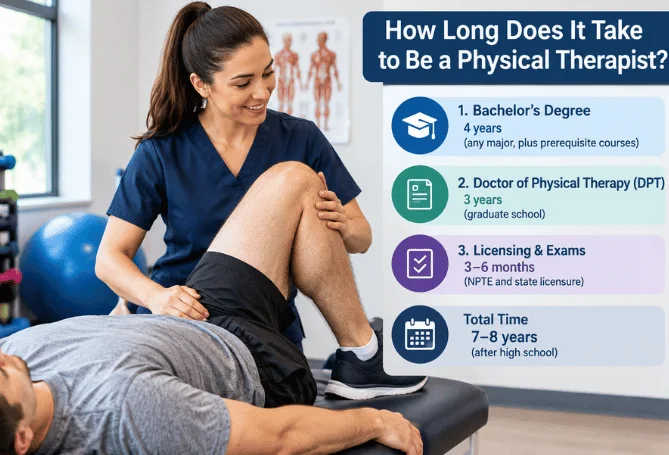
How long does it take to be a physical therapist in the United States? The standard path takes about seven years after high school. Most students spend four years in college and about three years in a Doctor of Physical Therapy program.
Most U.S. students need about seven years after high school before they can pursue licensure. The usual route combines four undergraduate years with roughly three years in a Doctor of Physical Therapy program. Accelerated 3+3 programs can reduce the academic path to about six years, while licensing adds scheduling and processing time.
| Stage | Typical time | What happens |
|---|---|---|
| Undergraduate study | About 4 years | Complete a bachelor’s degree and DPT prerequisites. |
| DPT program | About 3 years | Complete professional coursework, labs, and clinical education. |
| NPTE and state licensure | Varies | Meet state requirements, take the national exam, and receive approval. |
| Common total | About 7 years | Traditional college-to-license route |
| Accelerated option | About 6 years | Some 3+3 programs combine preprofessional and DPT study. |
| Optional residency | About 1 extra year | Advanced training after graduation and licensure |
Key Takeaways
- The most common U.S. route takes about seven years after high school.
- Most applicants complete undergraduate study before entering a professional DPT program.
- Some 3+3 programs can reduce the academic timeline to about six years.
- Every state requires licensure, and the NPTE is a major part of that process.
- Missing prerequisites or exam deadlines can add months or longer.
- A PTA program is a different career path and is usually much shorter.
How Long Does It Take to Be a Physical Therapist in the U.S.?
The seven-year estimate comes from combining undergraduate education with professional doctoral training. The U.S. Bureau of Labor Statistics says DPT programs typically last three years. APTA also says most programs require a bachelor’s degree before admission.
That timeline can change because schools structure admission differently. Some students enter 3+3 programs after three preprofessional years instead of completing four undergraduate years. Others need extra semesters for prerequisites, retaken courses, or application timing.
Step 1: Complete Undergraduate Study and Required Prerequisites
Most students begin with about four years of undergraduate study. Your major does not have to be physical therapy or another specific field. APTA lists exercise science, biology, kinesiology, and psychology among common undergraduate majors.
The important issue is completing each target program’s prerequisite courses. Common requirements include anatomy, physiology, biology, chemistry, physics, psychology, and statistics. Some schools also request observation experience, recommendations, interviews, or specific GPA standards.
Planning those requirements early can protect your timeline. A missing science sequence may delay an application cycle and extend graduation plans. Students managing demanding prerequisites may benefit from Thinkomics’ guide, Is Eddie Bauer Going Out of Business?
Step 2: Earn a Doctor of Physical Therapy Degree

New entrants need a professional DPT from an accredited program to prepare for practice. CAPTE is the recognized accreditor for entry-level PT education programs in the United States. Its directory lets students verify whether a program currently holds accredited status.
Professional DPT study usually takes about three years. APTA reports that programs combine classroom and laboratory learning with substantial clinical education. Students study areas such as anatomy, biomechanics, neuroscience, pharmacology, clinical reasoning, and patient management.
Clinical education is built into the degree rather than added afterward. That means you do not usually need another separate internship year before graduation. The professional program already includes supervised patient-care experiences across clinical settings.
Step 3: Pass the NPTE and Meet State Licensing Rules
Graduation alone does not authorize independent practice. Every state requires licensure, and the National Physical Therapy Examination is a central part of that process. FSBPT administers the NPTE and notes that jurisdictions may impose additional requirements.
The exam runs on fixed testing dates rather than every day. Candidates must also meet registration and jurisdiction approval deadlines before a scheduled administration. Missing a deadline can create a meaningful delay before the next available test date.
State processing times can also differ after the exam. Some jurisdictions may require jurisprudence testing, background checks, fees, or other documentation. Check the licensing board where you plan to practice before your final DPT term.
Can You Become a PT in Six Years?
Yes, some students can complete the academic route in about six years. APTA describes 3+3 programs with three preprofessional years followed by three professional DPT years. Some schools also admit freshmen into structured pathways with defined progression requirements.
An accelerated path works best when you know your goal early. These programs can require specific courses, minimum grades, and continuous progression through the sequence. Changing majors or schools may reduce the time advantage.
Speed should not be your only selection factor. Compare accreditation, total cost, graduation outcomes, clinical placements, and licensing performance before choosing a program. Thinkomics’ career advice section can help you compare education paths using more than program length.
What Can Make the Timeline Longer?
Several factors can push the total beyond seven years. The most common causes involve prerequisites, admissions timing, enrollment pace, and licensing logistics. Planning around these points can reduce avoidable delays.
- Taking undergraduate classes part-time.
- Changing majors and adding new prerequisite courses.
- Retaking science courses to meet program standards.
- Applying after a program’s annual deadline.
- Taking a gap year before professional school.
- Reapplying after an unsuccessful admissions cycle.
- Missing an NPTE registration or approval deadline.
- Completing optional residency or specialty training.
A longer route is not automatically a poor outcome. Extra time may improve academic preparation, reduce overload, or support a stronger application. Compare the full financial and academic picture before choosing the fastest option.
Physical Therapist Versus Physical Therapist Assistant
A PT and a PTA follow different education paths and have different professional roles. BLS says assistants typically need an associate degree from an accredited program and state licensure or certification. They work under the direction and supervision of licensed PTs.
Starting as a PTA is not a required step toward the DPT. APTA says PTA programs are distinct and do not automatically provide all prerequisites for professional PT education. Students changing paths may need substantial additional coursework before applying.
If you want a shorter healthcare training route, compare occupations before committing. Thinkomics’ sonography associate-degree guide shows another two-year healthcare pathway with clinical training. The comparison can clarify how much schooling you want before entering patient care.
Is Seven Years of Training Worth Considering?
The answer depends on your career goals, debt tolerance, and interest in patient care. The latest BLS data list a $102,760 median annual wage for PTs in May 2025. BLS also projects 12% employment growth from 2025 through 2035.
Those figures show strong national demand, but they do not guarantee a specific salary. Earnings vary with location, setting, experience, schedule, and other factors. Tuition and lost earnings during school should also be part of your decision.
Thinkomics’ guide to high-paying careers recommends comparing education time with cost, working conditions, and demand. That approach is especially useful for a doctoral-level healthcare career. A high salary can look different after years of tuition and limited full-time work.
A Practical Timeline From High School to Licensure
A simple plan makes the seven-year route easier to understand. The exact dates will vary by program and state. Use this sequence as a planning model rather than a guaranteed schedule.
- College years 1–2: Complete general education and begin core science prerequisites.
- College years 3–4: Finish prerequisites, observation requirements, and DPT applications.
- Professional years 1–3: Complete the DPT curriculum, labs, and required clinical education.
- Final DPT year: Review state requirements and prepare for NPTE registration deadlines.
- After graduation: Pass the NPTE, complete jurisdiction requirements, and wait for license approval.
Students in 3+3 programs may begin the professional phase after three preprofessional years. Other students may spend longer in college because of prerequisites or application timing. Your best estimate should come from the specific schools and state board you plan to use.
Frequently Asked Questions
How long does it take to be a physical therapist after high school?
Most U.S. students should expect about seven years of education on the traditional route. That usually means four undergraduate years and about three years in a professional DPT program. Licensing can add more time depending on exam scheduling and state processing.
Do you need a doctorate to become a PT?
New entrants generally complete a Doctor of Physical Therapy degree from a CAPTE-accredited program. APTA notes that older clinicians may hold earlier professional degrees and remain licensed. Current students should plan around the DPT pathway for entry into the profession.
What is the fastest common route?
A structured 3+3 program can reduce the academic path to about six years. Students complete three preprofessional years and then move into a three-year DPT phase. Admission and progression rules vary, so confirm each program’s requirements directly.
Does residency add another year?
A residency is optional rather than required for entry-level licensure. BLS says clinical residencies typically last about one year after graduation. They provide additional training in specialty areas but are not part of the standard seven-year route.
Is a PTA the same as a PT?
No, the roles and education paths are different. PTAs usually complete an associate-level program and work under PT supervision. Becoming a PTA first does not remove the DPT requirements for someone who later wants the PT role.
Plan Your Route Before Choosing a College
Start by identifying several CAPTE-accredited programs and comparing their prerequisite lists. Then build your undergraduate schedule backward from their admission deadlines. Early planning can prevent a missing course from turning a seven-year plan into a longer one.
Use official program and licensing sources for final decisions. Compare costs and career alternatives through Thinkomics before committing to a long graduate path. A realistic timeline helps you choose a route that fits both your career goals and finances.